Electric vehicles have already established a strong presence in Europe and accounted for over 25% of new registrations on the continent at the end of 2025. However, the decarbonization of road transport and personal mobility does not depend solely on the efficiency of engines or the capacity of on-board batteries.
There is another revolution under way beneath our tires, on the road itself. The challenge facing science is to transform asphalt into an active infrastructure capable of storing energy or interacting with vehicles, as a step toward achieving more sustainable mobility.
It was in 2006 that the American couple Scott and Julie Brusaw began to bring this idea to life. They created a hexagonal solar panel weighing 32 kilograms and 3.6 centimeters thick, with a surface area of about 0.4 square meters and equipped with heating elements (to prevent ice and snow from accumulating on it) that wirelessly connected to cars or other panels to provide drivers with information such as traffic alerts and energy generation data, as well as other useful information on weather, outages, roadworks, or traffic delays to help them make the best decisions while driving.
The goal of their company, Solar Roadways, was to generate renewable energy on other surfaces such as garage entrances, playgrounds, garden trails, or the edges of a pool.
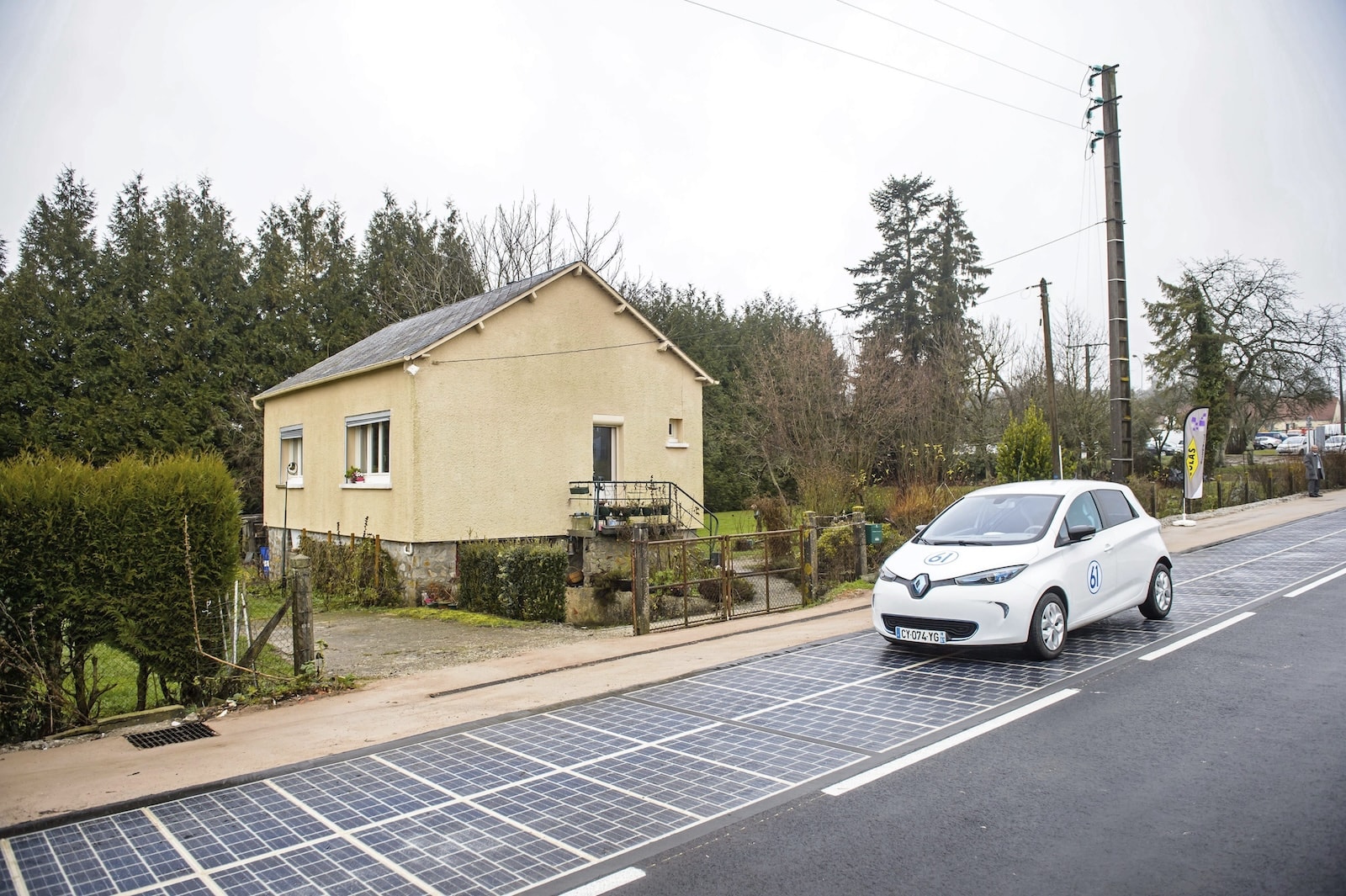
Another significant research project began a decade ago in Germany. The RWTH Aachen University joined forces with a local company to test roads with solar panels that generate energy to charge vehicles. Their easily recyclable glass-backed tiles with a lifespan of about 25 years were tested on bike lanes and sidewalks along urban roads. In France, we can find examples of other pioneering initiatives from the same period such as the world's first solar highway, which opened in Normandy in 2016. This 1,000-kilometer stretch made up of 3,000 solar panels features Wattway technology from the French company Colas, a subsidiary of Bouygues.
Along the same lines and at the same time, China unveiled a solar highway made of concrete that had very similar properties to its traditional counterpart, yet which was capable of providing protection for the solar panels mounted on its underside, enabling them to withstand heavy loads. These solar panels also featured wireless technology to charge electric cars traveling on the road via magnetic induction.
Solar roads currently being developed
Stellantis — the parent company of brands such as Citroën, Fiat, and Opel that a strong presence in Spain with its factory in Vigo — has a circuit in Italy called Arena del Futuro where it tests wireless dynamic wireless power transfer (DWPT) technology.
According to its research, a Fiat 500 equipped with this system can travel at typical highway speeds without using the energy already stored in its battery: it is powered by the energy received from the coils, meaning that the energy in the battery can be saved for use later on roads that do not have this service.
Moreover, the magnetic fields would not affect passengers. The circuit would be powered by direct current, which reduces power losses during energy distribution thanks to the use of thinner, aluminum cables that are more affordable and efficient.
Solar canopies on roads
While research is underway to enable electric cars to charge as they drive on roads, another option is to cover roads with solar panels to capture renewable energy.
One example is the PV-Süd pilot project being carried out between Germany, Austria, and Switzerland. At the request of these three neighboring countries, a consortium installed a 12-by-14-meter modular canopy on the German A81 highway in a rest area at a height of 5.5 meters. During this one-year pilot project, they were tasked with testing how a solar facility would perform with thousands of vehicles passing under it. According to the researchers, it could produce up to 40,000 kWh per year, enough to power ten households of four people each.
Electric mobility is not limited to the development of new engines and vehicles. It also seeks generation solutions — including in the asphalt itself — and sees roads as renewable solar energy sources and potential charging points. Projects such as induction roads or solar canopies demonstrate that infrastructure is evolving from a passive support structure into another potential source of sustainable energy.