Far from the spotlight, small islands scattered across Europe have shown that an energy model based almost entirely on renewable sources is not just possible, but already in place and operating successfully under real-life conditions.
Regions such as El Hierro in the Canary Islands and the Danish island of Samsø have become international benchmarks thanks to systems that combine wind, solar, and hydropower to significantly reduce their dependence on conventional energy sources. Their experiences also offer a roadmap for other regions seeking to achieve energy self-sufficiency and drive the transition toward a more sustainable energy model.
It is no coincidence that some of the most advanced initiatives have emerged on islands. The International Energy Agency (IEA) has repeatedly highlighted their potential as testing grounds for innovative solutions to integrate renewable energy and storage before implementing them on a larger scale. However, it also warns that these systems pose significant challenges, especially in terms of initial costs and infrastructure, since island territories often rely on more complex technologies to ensure the stability of the power supply.
The energy potential of island territories
The fact that these islands are remote — traditionally seen as a challenge when it comes to accessing external energy resources — has ultimately been a driving force of innovation. Without the option of relying on large mainland power grids, these islands have developed their own solutions to ensure their energy supply.
In this context, various studies on off-grid energy systems indicate that combining multiple renewable technologies with storage mechanisms is one of the most effective strategies for promoting decarbonization and increasing grid stability.
El Hierro: national leader in hydropower
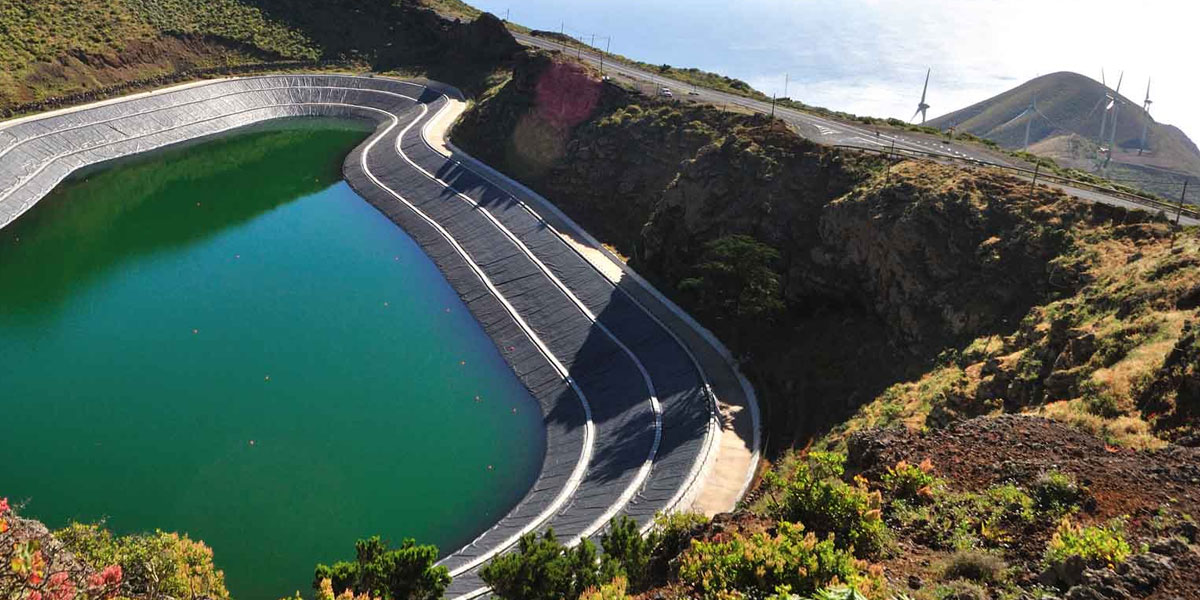
One of the best-known examples is El Hierro, the westernmost of the Canary Islands. For more than a decade, the island has been home to the Gorona del Viento wind-pumped hydro-power station, a pioneering facility that combines wind power with a water-based storage system. When the wind turbines produce more electricity than is needed, the surplus is used to pump water into a reservoir located at a higher elevation. Later, when the wind dies down, this water is released to generate electricity through hydroelectric turbines.
This system has enabled the island to operate exclusively on renewable energy for several consecutive days during certain periods. In 2019, for example, El Hierro managed to meet its entire electricity demand with renewable sources for 24 consecutive days, a milestone that cemented Gorona del Viento's status as one of the most notable off-grid power system projects.
The Danish "mirror"
More than 3,000 kilometers away in Denmark, the small island of Samsø underwent an equally ambitious transformation. In the late 1990s, it was selected by the Danish government as an energy transition testing ground. What began as a pilot project ended up becoming one of the most widely studied success stories on an international level.
The island opted for a combination of onshore and offshore wind farms, biomass-powered heating systems, and strong involvement of the local population in the financing and ownership of energy infrastructure. Within a few years, Samsø managed to generate as much renewable energy as its residents consumed, achieving a virtually neutral energy balance and significantly reducing its carbon footprint.
Malmö, European leader of the urban energy transition
Although islands are ideal settings for testing new energy models, some urban centers have also acted as innovation laboratories. One of the best-known examples is Malmö, Sweden, which is considered one of Europe's pioneering cities in terms of sustainable transformation.
After decades tied to heavy industry, Malmö began a profound economic and urban transformation in the late 20th century. One of its most iconic projects was the development of the Western Harbor (Västra Hamnen) district, built on former port and industrial land and designed with sustainability in mind from the very beginning.
The neighborhood incorporates solar and wind energy, smart energy management systems, efficient heating and cooling networks, and energy-efficient buildings, and has become an international benchmark in sustainable urban planning. In fact, the city plans to meet the goals of the Paris Agreement by 2030 and achieve carbon neutrality two decades ahead of the deadlines set by international commitments.
It demonstrates how many of the solutions implemented in small communities can also be adapted and scaled up to larger cities through proper planning, sustained investment, and a long-term vision of the energy transition.