Over the past decade, the deployment of renewable energy has largely focused on installing wind turbines and photovoltaic panels to increase its presence in the global electricity mix. However, as the sector has matured, the strategic focus has shifted towards the resilience and smart management of the grid. The distribution infrastructure is being converted to efficiently absorb diversified production.
Smart grids provide the digital architecture necessary to monitor and regulate energy flows in real time. These grids are a true technological evolution because they not only transport electricity but also act as coordinated systems that can automatically match supply and demand. In this context, optimization necessarily involves technological hybridization, which allows different renewable energy sources to share the same grid connection point. This maximizes the use of existing infrastructure and reduces evacuation losses.
The economic viability of the continuous electricity supply
One historical argument raised against the widespread use of wind and solar technologies is their inherent intermittency. However, innovations in hybridization and storage have technically neutralized this limitation, making a 24/7 supply possible. This is of extraordinary interest to energy-demanding actors such as artificial intelligence (AI) infrastructure operators and large data centers because their business models require a sustainable but uninterrupted supply.
A report published in May 2026 by the International Renewable Energy Agency (IRENA) titled "24/7 Renewables: The Economics of Firm Solar and Wind", concluded that the combination of solar photovoltaics, wind energy, and storage has the technical capacity to provide continuous, reliable electricity.
Hybridization compensates for seasonal and daily variations in both resources, such as maximum solar production during the day and nighttime wind regimes. Batteries absorb surplus power for release during peak demand or when direct resources are limited.
Batteries, green hydrogen, and reversible hydraulics: key to storing renewable energy
The shift from single-technology projects to integrated energy complexes is changing how European companies and investors plan. Adopting hybrid systems equipped with storage is not an experimental technology movement, but rather the preferred method for developing the electrical system.
According to projections published by the international consultancy Aurora Energy Research, hybrid renewable energy projects that incorporate battery storage systems could experience growth exceeding 450% in Europe by 2030. This projected increase positions the combination of generation and storage as the operational standard for new utility plants.
In 2025, prices were negative for more than 500 hours in countries such as Spain, Germany, and the Netherlands due to large-scale renewable energy production and low demand. Thus, battery storage can help mitigate the phenomenon of zero or negative prices, and respond to system operators' requirements for network adjustment services that instantly guarantee system frequency and voltage.
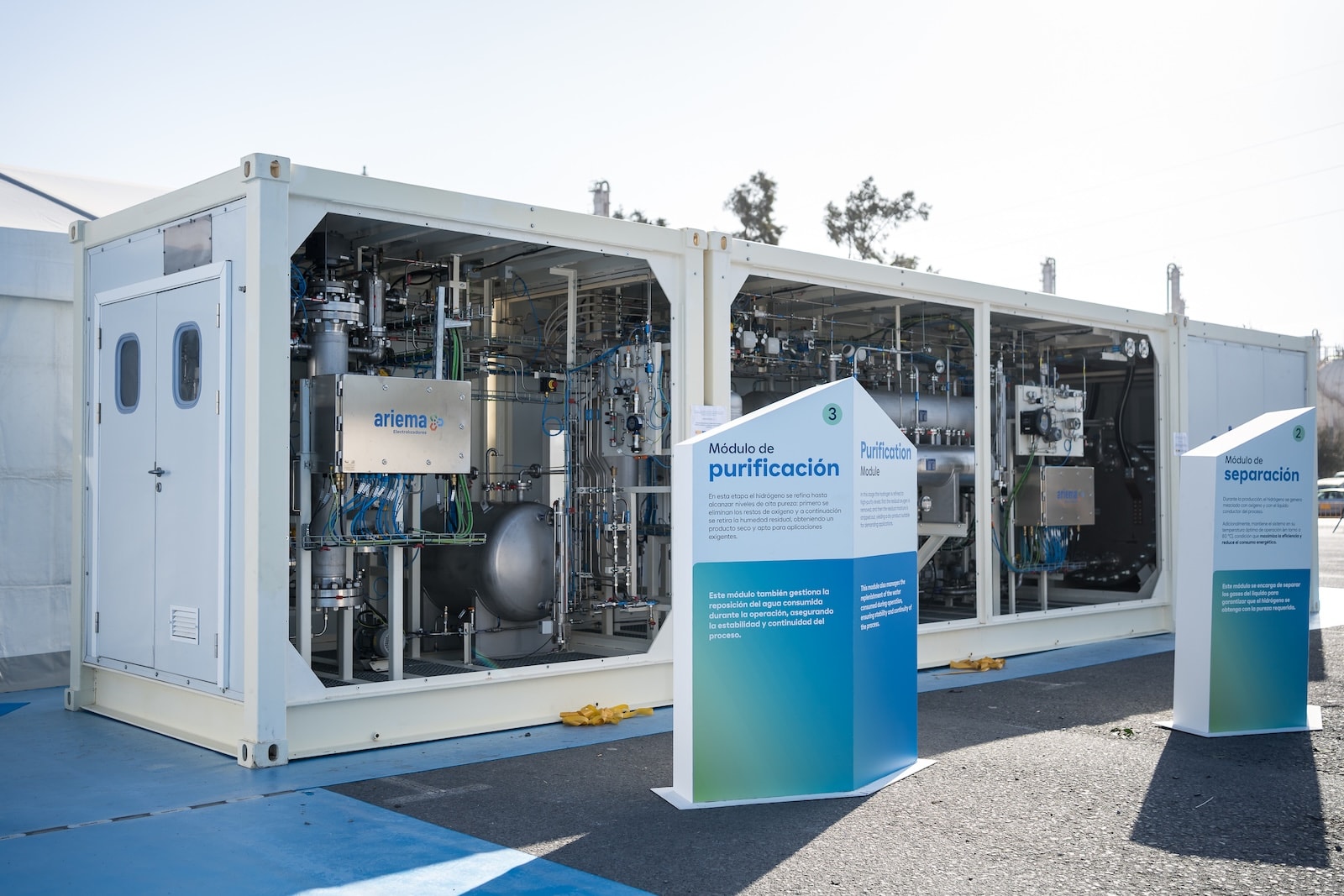
However, the system's flexibility does not depend solely on batteries. Green hydrogen production allows renewable energy surpluses to be transformed into a sustainable, storable fuel which can be used in sectors that are difficult to electrify directly, such as heavy transport or maritime. Thus, hydrogen acts as a form of energy storage by converting surplus renewable electricity into a storable, transportable energy source that can be used as needed. In this regard, the European Commission is maintaining REPowerEU's goal of producing 10 million tons of renewable hydrogen in the EU and importing another 10 million tons by 2030, with a view to continuing to drive decarbonization.
Similar logic is found in reversible hydraulics, which store energy by pumping water to a higher reservoir during periods of excess electricity and recovering it by generating power during periods of peak demand. According to the International Energy Agency, reversible hydraulics accounted for over 90% of global electrical storage capacity in 2020, reaching nearly 8,500 GWh worldwide.
In both cases, the principle is the same: it is not just about storing electricity in batteries, but about transforming the excess energy into other energy sources or storage solutions that can be managed over time when they are most needed, thus providing flexibility in the electrical system.
The evolution of smart grids equipped with hybrid complexes makes it easier to decentralize the energy map. Each node in the network becomes a potential microgrid, combining distributed generation, storage capacity, and energy conversion. This minimizes dependence on large, high-voltage transmission lines and provides the entire infrastructure with robustness against possible technical failures or weather contingencies.