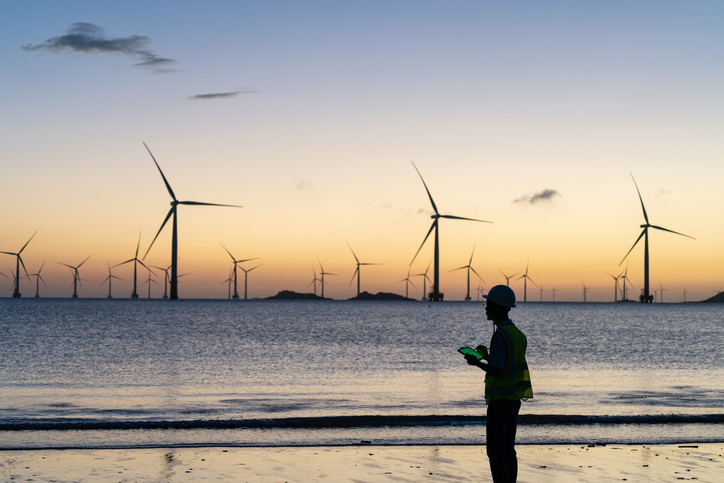
Over 70% of our planet's surface area corresponds to seas and oceans. Optimizing the use of this enormous extension for power generation has great appeal and is a clear opportunity. The energy transition has therefore found an inexhaustible ally in the sea.
Offshore wind power is not just the replication of onshore technology in the water, but it can represent a qualitative leap in terms of efficiency and stability. Depending on its location, stronger and more consistent winds than those on land can be harnessed at sea, thereby increasing its potential.
The year 2025 marked a historic milestone for the European offshore wind industry. According to the data from the 2025 Sea Impact report, the continent installed a record capacity of 6,773 MW in a single year. Moreover, the European Union plans to install at least 100 GW of offshore wind capacity between 2031 and 2040, consolidating this renewable source as one of the key pillars for driving the decarbonization and energy autonomy of the continent.
Denmark, for example, installed the world's first offshore wind farm in 1991 and continues to lead innovation in offshore wind farms and hybrid solutions, such as the development of an "energy island" that will provide green energy to more than five million homes. Meanwhile, the German Federal Network Agency (Bundesnetzagentur) awarded tenders for offshore wind farms in August 2024 with a total capacity of 5.5 GW. This mobilized over 3 billion euros for the German state, of which 90% will be allocated to reducing electricity costs, and 5% to protecting marine biodiversity. The Netherlands has also expressed its goal to reach 21 GW of offshore wind capacity by 2030.
Besides an environmental issue, investment in this technology is an economic lever. Only in the first half of 2025, Europe committed 22 billion euros in final investment decisions for new offshore wind farms, a figure that reflects the continent's commitment to foster the deployment and development of this energy source.
Seanergies: industrial metamorphosis in the Ferrol estuary
While the deployment of wind turbines along Spain's coastline is moving forward in anticipation of the first commercial tenders, Spain is already becoming a powerhouse in the manufacturing of their components. The prime example of this strength is Navantia Seanergies, the brand created to channel naval expertise towards green energies.
The Fene shipyard, located in the Ferrol estuary, has undergone an unprecedented transformation. What for decades was a center dedicated exclusively to traditional shipbuilding, is now one of the most advanced factories for wind foundations in the world. This evolution did not start from scratch; rather, it has built on decades of experience in complex metal structures and the management of large-scale industrial projects, leveraging the expertise gained over the years to adapt to a new landscape, with a focus on sustainability.
The crown jewel of this transformation is the XXL monopile factory, developed in collaboration with Windar Renovables. These are steel cylinders of colossal dimensions, more than 10 meters in diameter and nearly 2,000 tons in weight, which serve as the base for the wind turbines.
By 2030, Navantia will have allocated more than 50 million euros to adapt the Fene shipyard, including the modernization of facilities for bending thick plates and the creation of logistical storage areas. The contract for the British East Anglia 3 park alone has generated nearly 900,000 work hours and 450 direct and indirect jobs in the region.
Fene is currently the only center in Europe capable of simultaneously producing the three major foundation technologies: jackets (lattice structures), monopiles, and floating platforms.
A future driven by innovation
Offshore wind now faces the challenge of maturity and technological resilience on a global scale. In this context, the Global Offshore Wind Alliance (GOWA), officially presented during COP27, is playing a decisive role as an international driving platform. Founded by the Government of Denmark, the International Renewable Energy Agency (IRENA), and the World Wind Energy Council (GWEC), GOWA's main mission is to unlock the massive potential of this energy source. Its goal is ambitious: to reach at least 2,000 GW of installed capacity by 2050. This deployment aims to support climate goals, strengthen global energy security, and accelerate the shift towards sustainable energy sources, in line with the Paris Agreement.
According to GOWA, offshore wind energy already supplies 83 GW worldwide, costs have fallen by 62% since 2010, and each additional GW can generate up to 17,500 jobs.
Through centers of innovation and public-private collaboration, Spain is demonstrating that green reindustrialization is possible. The Ferrol estuary no longer looks to the sea just for navigation, but to support the infrastructure that will supply millions of homes with renewable energy over the next decade.