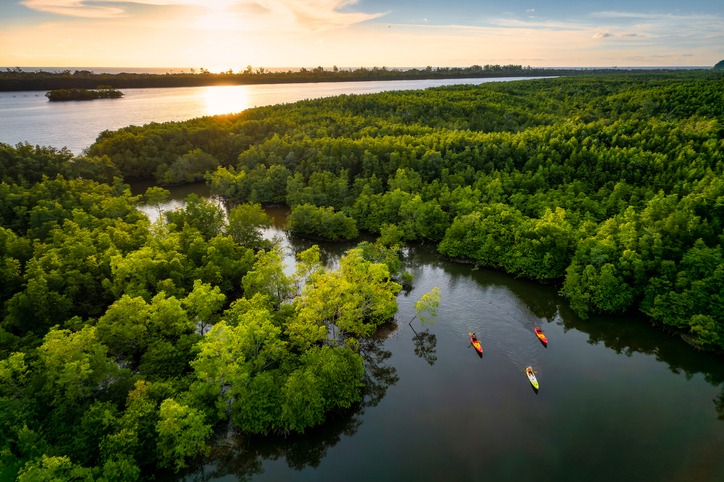
Mangrove forests are among the most valuable tropical ecosystems on Earth, both for their beauty and for their environmental function. The United Nations (UN) defines them as coastal wetlands made up of trees and shrubs that grow in intertidal zones of salty water in tropical and subtropical regions. They are also known as blue forests, given their remarkable ability to absorb and store CO₂ from the atmosphere. This is because mangroves thrive in waterlogged soils rich in brackish water (a mixture of salt and fresh water) where organic matter decomposes very slowly and accumulates beneath the surface. As a result, the carbon captured by the plants remains trapped in the mud for centuries instead of quickly returning to the atmosphere. In quantitative terms, mangroves capture about 15% of the carbon along all coastlines, even though they represent only 1% of the world’s tropical forests. Some studies further suggest that they can capture up to five times more carbon than terrestrial rainforests.
A large portion of these ecosystems stretches across Amazonian South America, covering countries such as Peru, Ecuador, Colombia, Bolivia, Venezuela, Guyana, Suriname, and French Guiana. However, Brazil holds the majority: nearly 12% of the world’s mangroves. In fact, at the mouth of the Amazon River and along its adjacent coasts lies the planet’s largest mangrove forest, spanning more than 7,800 sq. km.
Beyond their global importance, mangroves also deliver local environmental services. Their dense root and trunk systems act as natural barriers against storms and tidal surges, absorbing wave impact and reducing coastal erosion. Similarly, these wetlands filter sediments, plastics, and pollutants that would otherwise flow into the open sea. In this way, mangroves function like an ecological kidney, preserving water quality.
But their value extends beyond the environmental: mangroves also play a major social and economic role for nearby communities. In the northern regions of several Amazonian countries, artisanal fishing of crabs, mollusks, and fish within these forests is an essential part of local life. In some parts of Brazil, mangrove-derived catches represent up to 50% of total artisanal fishing output. Entire families wade into the mud to collect uçá crabs, oysters, shrimp, and other species, following ancestral, traditional methods passed down through generations. These forests are even intertwined with cultural identity; in riverside Amazonian villages, local legends still tell stories about the mangroves.
Today, the future of the Amazon’s mangroves extends far beyond national borders and has become a global concern. It’s no coincidence that the most recent COP30 Climate Summit (November 2025) was held in Belém, the gateway to the Brazilian Amazon. For years, scientists, indigenous leaders, and civil society organizations have stressed the need for concrete commitments to protect mangroves and similar ecosystems. The planet’s balance, connected by the arteries of its rivers, seas, and oceans, depends greatly on these ecological “kidneys,” which is why the health of the blue protectors of the Amazon is essential to global well-being.