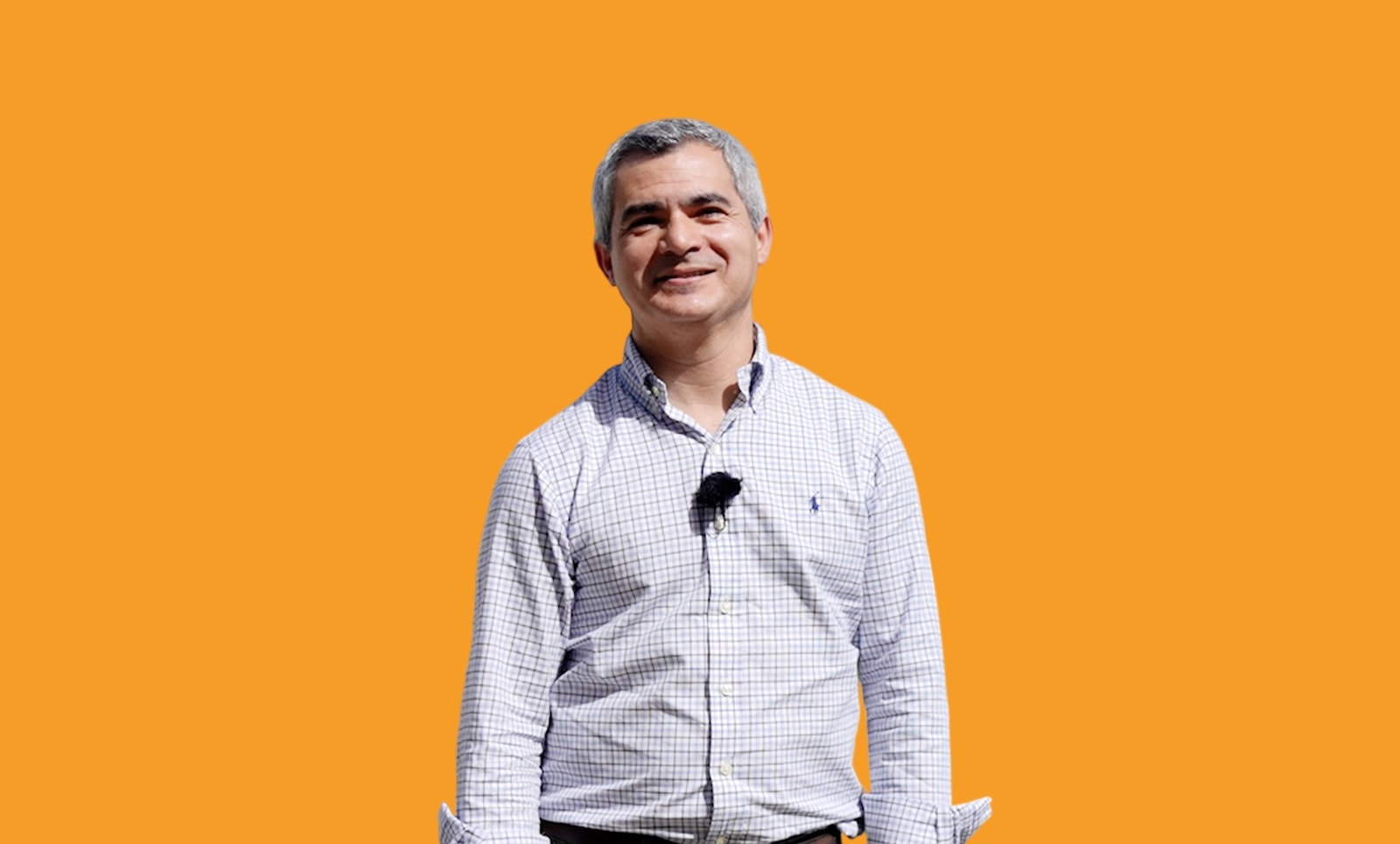
Based within Avila's city wall, Nagami has become one of the world's leading specialists in large-format robotic 3D printing, using only recycled and recyclable plastic. We spoke with its CEO and founder, Manuel Jiménez
Nagami’s story combines technical expertise, a business idea, the determination to bring it to life, and a touch of serendipity. Manuel Jiménez, an architect from Ávila—like his brother and business partner—moved to London and soon took the helm of the Design Computation Lab (UCL). That’s how his love affair with 3D printing began, until the management of the Centre Pompidou in Paris asked them to create an object for the exhibition “Printing the World.” The result was the Voxel Chair, a chair printed in mid-air and the first prototype designed using innovative software specifically for large-format robotic 3D printing, which is now part of the Parisian center’s permanent collection.
This groundbreaking idea caught the attention of Zaha Hadid, Ross Lovegrove, and Daniel Widrig, three leading figures in design and architecture. Ten years later, Nagami has 21 3D printers and 36 employees; its creations can be seen in places as diverse as the Santiago Bernabéu Stadium and the Dior and Ecoalf stores.
What is Nagami, and where does it come from?
Manuel Jiménez García. The company was born out of love for design and architecture, and a desire to build a more sustainable future. We’ve always wanted to develop technology that would help us on that path, and 3D printing is the answer. It allows us to work with recycled and sustainable materials, while also creating completely different objects each time. It’s versatile because it can automatically respond to needs and demand. The technology itself is already fully circular, and it represents a shift in the way the industry thinks.
Nagami started with that legendary chair, and today you can print parts up to three and a half meters long. What kind of technology makes that leap possible?
When we started in 2016, with that almost naive enthusiasm, vertical extruders (the devices that extrude the filament) didn’t exist for mounting on a robot. We quickly realized that we needed to develop our own solution. We’re now on version number seven. What’s more, our proprietary technology allows us to grow and scale much faster, more nimbly, and more cost-effectively, until we become the world’s largest brand in large-format robotic 3D printing.
Do you combine design and engineering in the creative process?
For us, they’re almost two sides of the same coin. It’s a different path from that of an architect or an engineer, because to design, you have to understand a technology that dictates the rules within your design process. And at the same time, you know that when you push the machine a little further, you’re trying to open the door to new technological developments. We could say that Nagami’s designers are also engineers, architects, technologists… It’s a blend of different interests that doesn’t fit neatly into a single profession.
What examples would you highlight of what this creative technology—or this technological creativity—can achieve?
It’s hard to pick just a few, but in addition to the chair for the Pompidou, I’d say the chairs we made with Hadid, Lovegrove, and Widrig for our 2018 launch. It was literally a battle against gravity to create an object that was impossible to make. How can we rethink, through digital design and 3D printing, an everyday object like a portable toilet? The answer is The Throne, the first object we printed that stood 3.5 meters tall. Also, the Dior store allowed us to reflect ideas, patterns, and imagination in our first façade. And the Ecoalf flagship store at Las Rozas Village, our first complete interior design project.
What role does sustainability play in the creation of these unique structures?
We only use recycled and recyclable plastics sourced from various places—the oceans, hospitals, and so on—as well as recycled plastics mixed with organic waste such as coffee grounds, olive pits, or oyster shells to achieve specific properties in the material, such as a glossy, matte, or satin finish, a particular reflectivity, or the ability to withstand different structural stresses. When we started out, sustainability wasn’t as important, but we believe in it wholeheartedly. That’s why developing machinery to work with these types of plastics was a complex process.
Plastic isn’t going to disappear, but it will be recycled, it will be replaced, and we’ll create other types of materials. In reality, artificial intelligence, technological advancements in manufacturing, and chemical innovations in materials will help us save the planet and begin to create industrial and consumer processes that are far more sustainable and circular.
How does the industrial 3D printing process itself contribute to sustainability?
It is, in and of itself, the most sustainable option, with a minimal carbon footprint. These are versatile and portable machines; in fact, we’ve often taken a robot on-site to print the objects the client requested. We don’t have to keep inventory because you can create one object now and a completely different one later—from a vase to a chair, from a wall to a structure. You can respond to demand much more quickly. We can create what we need—and only what we need—close to where we need it, without generating a carbon footprint from long-distance transportation. The future of 3D printing lies in distributed manufacturing, and we’re launching several partnerships across different continents to make this possible.
Will it eventually become standard practice in construction and architecture?
Yes, it’s scalable. Our project originated in architecture, and we quickly moved on to printing on a larger scale. Today we’re building corridors hundreds of meters long and enveloping entire stores; we have several outdoor projects and are in negotiations for even larger ones were, perhaps, 50% of the building or all the interior walls will be printed with recycled plastic. In the future, it could even be the entire structure. We’re moving toward a more industrial scale and, therefore, toward lower costs because the more robots we have, the cheaper it is to produce. Construction processes can be accelerated, but above all, we can envision a different kind of architecture.
Finally, why Ávila as the birthplace of Nagami and its innovative approach to 3D printing?
After giving it a lot of thought, I couldn’t find a better place to develop it. It’s my hometown, my brother’s hometown and business partner, and of many of our employees. It’s a place I saw as full of opportunities, with affordable spaces and the ability to navigate easily among different sectors of the local industry. We’ve grown within that magical contrast between a walled, medieval city and robot's 3D printing—printing the future. I think this is something we should explore much more in other parts of Spain: using depopulated areas as an advantage to innovate and foster a different kind of industry.