The changing energy landscape calls for new ways to store large amounts of energy. Solar and wind technologies are advancing rapidly, but storing the electricity they generate efficiently remains a challenge. Renewable hydrogen offers a promising way to meet that need.
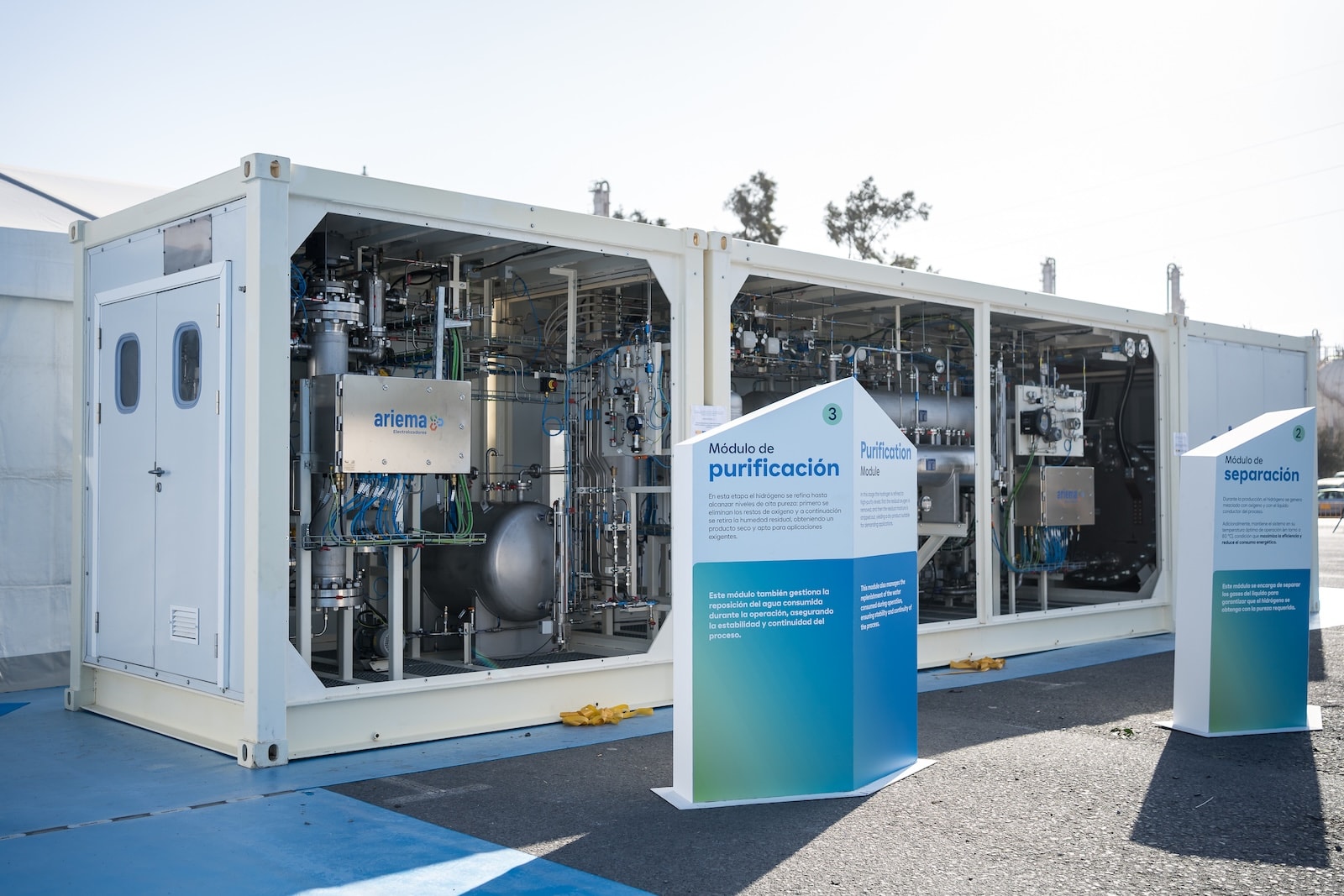
At the heart of hydrogen production is the electrolyzer. Put simply, it uses electricity to split water molecules into hydrogen and oxygen.
Hydrogen can carry energy, be transported, and stored for months. When the electricity used to produce it comes from renewable sources, the resulting carbon-neutral chemical fuel produced would act as a bridge between renewable power and industrial sectors that are difficult to electrify, through the so called “green molecules”.
What happens inside an electrolyzer?
The process takes place in electrochemical cells containing an anode (positive electrode), a cathode (negative electrode), an electrolyte that conducts ions, and a specialized membrane. The membrane keeps the gases produced apart while allowing certain ions to pass through and complete the electrical circuit. When purified water enters the cell and a direct current is applied, the water molecules (H₂O) split through two linked reactions.
The first reaction takes place at the anode, an electrode where oxidation causes water molecules to release electrons. The molecules split, producing oxygen gas (O₂) and positively charged hydrogen ions, or protons. According to the International Energy Agency (IEA), oxygen is a harmless byproduct that can be released into the atmosphere without leaving a carbon footprint.
The protons produced at the anode pass through the electrolyzer’s selective membrane to the cathode, where a reduction reaction takes place. At this negative electrode, they gain electrons and combine to form hydrogen gas (H₂). Hydrogen is the most abundant element in the universe and an important renewable energy carrier. However, it is difficult to obtain directly from nature, so it must be produced.
The hydrogen is then purified and compressed at high pressure, ready to be fed into transport networks or stored. In storage, it acts like a large, energy-dense chemical battery. That, in essence, is the electrolyzer’s role in producing renewable hydrogen: converting electricity into a form of energy that can be stored and transported.
The technical challenge of proton exchange membranes (PEM)
There are several types of electrolyzers, the most common being alkaline (ALK) and proton exchange membrane (PEM). PEM electrolyzers are particularly valued for their operating flexibility: they can adjust their output almost instantly to match fluctuations in electricity generation from wind and solar farms.
Beyond the strategic benefits offered by its potential for energy storage, electrolyzers—and the hydrogen and hydrogen-derived fuels they produce—could play a crucial role in decarbonizing sectors that are difficult to electrify, as discussed in Nature Energy. These include energy-intensive industries, aviation, and long-distance shipping.
The electrolyzer’s true strategic value lies in its ability to address the challenge of energy storage on a global scale. Hydrogen produced through electrolysis offers a viable way to ensure a reliable, stable energy supply from renewable sources in the future. Ultimately, electrolyzers could serve as a catalyst for the energy transition, with a focus on competitiveness and strategic autonomy.