“Yes, my friends, I believe that water will one day be employed as fuel, that hydrogen and oxygen which constitute it, used singly or together, will furnish an inexhaustible source of heat and light, of an intensity of which coal is not capable.” Jules Verne, The Mysterious Island (1874).
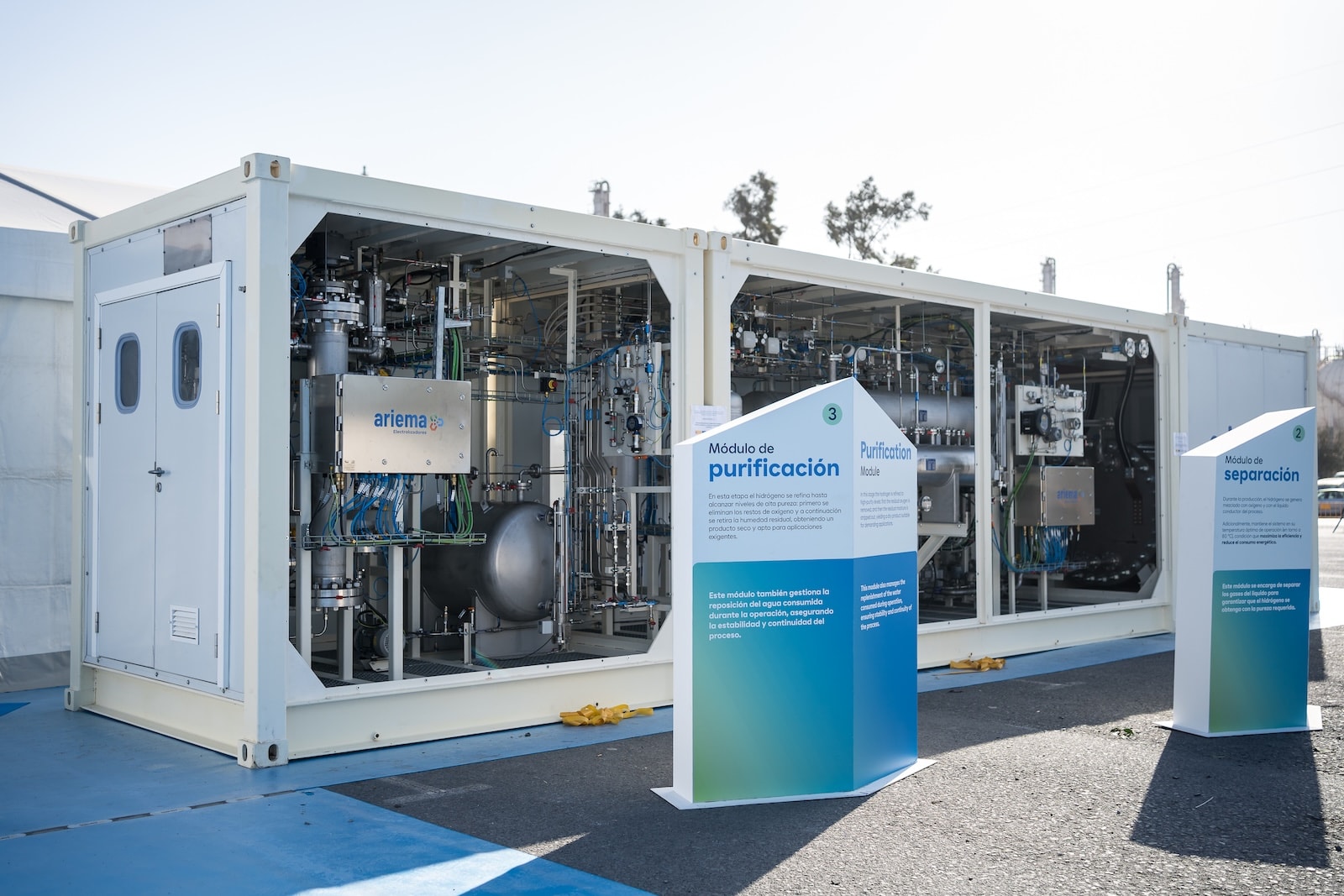
The French writer’s adventures usually took place under the sea; today, energy and industrial innovation travel across the surface and are behind some of the most significant industrial projects driving the energy transition in Spain. Four have been selected. What they all have in common is that they are steering a range of key industries toward a greener world through solutions that span everything from electrification and batteries to biofuels and renewable hydrogen. Jules Verne would be fascinated by an experience that might begin, for example, with the production of renewable hydrogen using electrolyzers. In other words, separating hydrogen and oxygen molecules using renewable energy. In mid-2025, according to the World Bank, there were some 2.15 GW of capacity in operation worldwide. “An initial interesting feature of these kinds of initiatives is that they are integrated into the industrial or logistics facility or data center, which avoids transportation and distribution costs,” observes Roberto Scholtes, head of research at Singular Group bank.
Cost is one of the defining features of the enormous facility where Volkswagen, together with its partners, is building a plant in which it has invested €10 billion as part of an initiative called Future Fast Forward, which aims to electrify the automotive industry. Its flagship project is a battery plant under construction in Sagunto. According to the timeline set by its subsidiary, PowerCo, the plant is expected to begin operations in December of this year. It is being built in four blocks with very strict insulation specifications. The first has an industrial capacity of 20 GWh, which means at least some 55,000 lithium iron phosphate (LFP) cells per day. Although the plant is designed to produce 40 GWh, it has enough room to expand to 60 GWh depending on demand. That initial output of around 20 GWh is equivalent to cells for 200,000 electric cars a year. It is undoubtedly a complex piece of infrastructure, requiring an investment of €3 billion, and a key facility for the Valencia region, which has made a strong commitment to this industry and is already attracting numerous companies from the surrounding area. This initial phase will create some 500 direct jobs, with the potential to reach 1,500. The batteries are destined for Volkswagen Group factories in Martorell, Barcelona, and Landaben, Navarre, where they will power electric vehicles from Group brands such as Skoda, Cupra and Volkswagen.
Turning to the big numbers, it is worth noting an investment of some €4.1 billion and around 4,000 direct jobs once the plant is at full capacity. These are the key figures for the gigafactory built in Figueruelas, Zaragoza, by Stellantis (Peugeot, Opel, Citroën and Fiat) and Chinese company CATL, the world’s largest battery manufacturer. The partnership has given rise to the joint venture Contemporary Star Energy. The gigafactory is expected to begin producing cells at the end of this year. The new facilities will cover 89 hectares and, in 2027, before it has even reached maximum output (50 GW), it will account for more than 5% of Aragon’s GDP. “We see this as a strategic investment for the region,” says economics professor José García Montalvo, “because it connects the existing automotive industry with a technology that is central to electrification.”
The batteries will be LFP (lithium iron phosphate) batteries, which will lower the cost of the group’s vehicles. This technology, the professor points out, already accounted for more than 55% of the batteries installed in electric vehicles worldwide in 2025. It is not a niche bet but an industrial one, built on low cost, competitiveness and durability. “Its main regional advantage is the way it complements Figueruelas and its supplier network: producing batteries alongside assembly lowers logistics costs and strengthens the automotive hub’s shift to electric vehicles,” Montalvo explains. In fact, it encourages manufacturers of cathode materials, electrolytes, separators and casings to set up in the area, along with recycling, automation and engineering services. CATL has stated its intention to gradually localize production of these components in Europe. “The priority should be to develop local suppliers and capabilities, along with technical training, competitive energy and infrastructure,” the professor adds. “This plant will be especially valuable if it helps transform existing companies and attracts new activities.”
From Zaragoza to Huelva. We step inside Moeve’s 2G biofuels plant. Next year, it will begin producing these second-generation biofuels in the town of Palos de la Frontera, in the province of Huelva. With the start-up of this facility, the energy company and its partner Apical are driving the largest industrial complex for this type of biofuel in southern Europe. It is expected to create some 2,000 direct and indirect jobs. It offers an answer for sectors that are very hard to electrify because of their dependence on fossil fuels. Think of air, sea and heavy road transportation. “It is a technological challenge, but we can’t wait until we have all the answers. We have to start down that road now,” advises Diego Vizcaíno, a partner at Analistas Financieros Internacionales (AFI). “Heavy transportation needs solutions, and these biofuels are one of them. They help decarbonize the hardest-to-abate sectors, provide strategic autonomy, drive industrial development and add value to waste,” he stresses. With an associated investment of €1.2 billion, the plant will have a flexible production capacity for HVO and SAF (sustainable aviation fuel) of some 500,000 metric tons a year, bringing the company’s total biofuel production capacity to more than 1.5 million metric tons a year. As a result, Andalusia is at the forefront of Europe’s hubs for green molecules and fuels free of CO2.
Against this backdrop, construction is already underway on the first phase of the Andalusian Green Hydrogen Valley, which will initially have 300 MW of electrolysis capacity. In this first stage, known as Onuba, Moeve, together with its partners COFIDES, Hy24, Enagás Renovable and Alter Enersun, is investing €1 billion. The project has also received €303.75 million in public funding through the PERTE ERHA (Strategic Project for Economic Recovery and Transformation in Renewable Energy, Renewable Hydrogen and Storage), part of Spain’s Recovery Plan financed by NextGenerationEU funds.
These are the pillars of a world-leading hub for green molecules in Spain and Europe. It will produce some 45,000 metric tons of renewable hydrogen a year and, in hard-to-decarbonize sectors, prevent the release of 250,000 metric tons of CO2 into the atmosphere every year. Onuba, which the EU has also designated a Project of Common Interest (PCI), will create more than 8,000 direct, indirect and induced jobs across the entire value chain over the various phases of the project. “This is very good news, as it will act as a driving force for the economy,” Diego Vizcaíno emphasizes. For now, 400 local SMEs and self-employed professionals will contribute their products, work and services. “Civilization never recedes; the law of necessity ever forces it onwards.” Jules Verne.