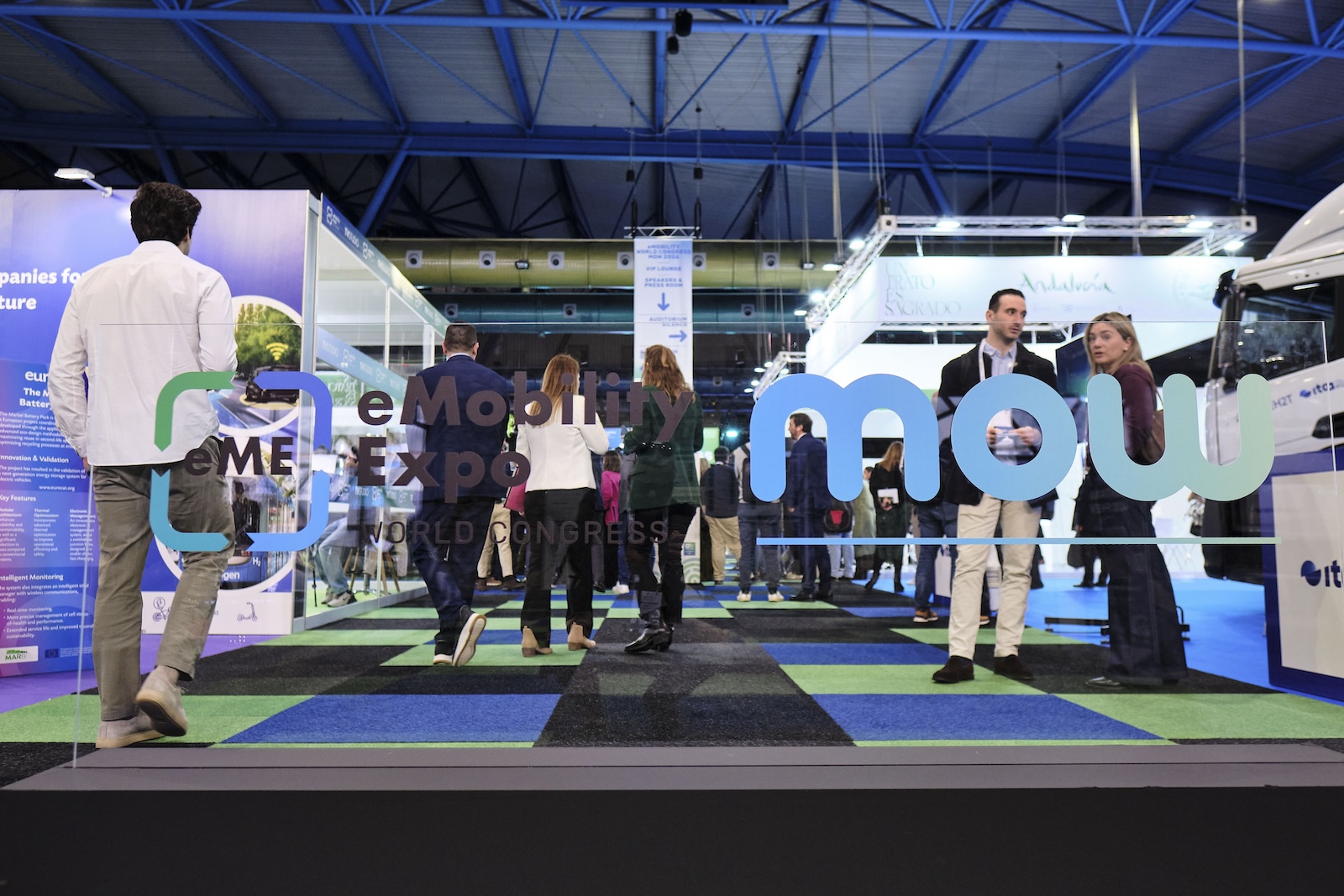
The 'eMobility Expo World Congress-MOW 2026', held in Malaga on March 10 and 11, brought together the main players of European industry involved in sustainable, autonomous, electrified, mobility, and safe mobility in a unique event in which more than 375 experts participated to devise the mobility of the future.
“2026 will be a year marked by significant challenges, but also by significant opportunities,” said Pierre-Yves Sachet, Executive Vice President of Mobility at Moeve. He emphasized European progress in the energy transition, highlighting the concept of multi-energy, aimed at meeting customer needs.
The director of the conference, José Ramón Sierra, stressed that mobility is “one of the great transformations of our time.” Driven by the emergence of new technologies and improved energy systems, it is pushing the redesign of cities and also leading industry to adapt to the new challenge. In his opinion, given the complexity of this evolution, the future of mobility will not be built by a single company or a single sector, but by “an entire ecosystem working together.”
In line with the vision of both executives, Moeve's Head of New Energies, David García, pointed out in his speech at one of the round tables held on the first day (Sustainable Cities) that the user must be placed at the center of decisions and the mobility of all drivers must be taken into account, regardless of their needs. He therefore specified that Moeve's electric vehicle charging stations are designed to facilitate accessibility as much as possible, with enough space to get in and out of the vehicle without difficulty and with hose management systems that make them easier to use. García took the opportunity to highlight the need for public administrations to “help” plan cities for the present and future, integrating new technologies and energies into them.
On the subject of regulation, Mónica Martín Abad, Mobility Product Development at Moeve, focused—in her participation in another panel discussion—on “the need for stable regulatory frameworks and clear signals to the market for the decarbonization of freight transport.” “When regulation, investment, and demand do not advance at the same pace, uncertainties arise that slow down the transition,” Martín reflected during her speech at the forum.
The Iberian Peninsula, a strategic location
One of the central topics of the debate was precisely the decarbonization of road transport. Sachet, executive vice president of Moeve, explained that “there is no single solution,” but rather a need to offer the right energy for each case. In the case of light vehicles and urban mobility, for example, battery electric vehicles are probably the most efficient solution today.
From an environmental perspective, Xavier Giménez, professor of Environmental Chemistry at the University of Barcelona, stated that we must take action to mitigate climate change and promote decarbonization and the development of more sustainable energies, for which he calls for a broad and flexible view of the situation.
European demand in this regard is unequivocal. Battery electric cars accounted for 19% of registrations in the European Union in January 2026, an increase of 4.4 percentage points over the previous year, confirming that electrification is becoming a market reality and a consumer trend.
In this context, the Iberian Peninsula has become a strategic point in Europe. In Portugal, in January 2026, approximately 26% of vehicles were fully electric. In the same period, in Spain, electrified vehicles accounted for around 19% of registrations and fully electric vehicles reached 8.26%, demonstrating that the transition is accelerating. According to the latest report published by AEDIVE, Spain has a more favorable ratio of electric cars per public charging point than several larger and more established electric vehicle markets, such as Germany, the United Kingdom, Belgium, Denmark, and Sweden.
The growth rate of the charging infrastructure in Spain has outpaced the growth of its electric vehicle fleet more efficiently than in countries with a higher volume. For example, Moeve offers an extensive ultra-fast electric charging infrastructure at service stations in Spain and Portugal, equipped exclusively with chargers of at least 150 kW, capable of charging 80% of a vehicle's battery in approximately 10 to 20 minutes.
Martín Abad emphasized the need to cooperate and coordinate policies and actions among the actors involved in the process. "Decarbonization of transport," he stressed "is such a complex challenge that it cannot be carried out in isolation: there must be cooperation and coordination of the entire ecosystem to establish a successful roadmap towards the transition."
The prominence of green hydrogen
Green hydrogen was one of the most mentioned terms in this congress. The Moeve executive emphasized that this renewable gas is one of the main levers in the challenge of decarbonization. So much so that the EU wants to increase its development until it accounts for 25% of Europe's energy consumption, promoting projects such as the Green Hydrogen Valley in Andalusia, which will become the largest renewable hydrogen project in southern Europe. In fact, the board of directors of the company has already approved the final investment decision to begin construction.
During the two days, several round tables were held to analyze the situation from different angles: development, regulation, production, application in urban systems, etc. One of them focused on industrial scale, infrastructure, and the race for its implementation, with the participation of Daniel Fraile, Chief Policy and Market Officer at Hydrogen Europe; Francisco Rubio, Senior Business Development at Moeve; and Andy Weinstein, CEO at GODOT.
In it, Rubio considered that renewable hydrogen positions itself as an energy vector capable of replacing other sustainable energies in areas where "it is more difficult to bring them." Hence, the popularity of its use faces a series of challenges that need to be resolved and that refer to the cost of the vehicle and its availability, the economic cost of investment in infrastructure, and the need to reach a price of the molecule capable of competing with other energies, essential for the customer, especially professional.
As indicated, an appropriate regulatory framework is needed and to find the balance so that the company can profit from the sale of energy and the end customer perceives an appeal in switching to sustainable energy, which truly represents a saving for them.
For his part, Daniel Fraile, Chief Policy and Market Officer at Hydrogen Europe, argued that “cheap energy” can be achieved in southern Spain, provided that multi-energy is developed and complementary technologies such as hydrogen are available, which he considers to be a good option for electric buses.
Advanced assisted driving systems, personal mobility scooters with removable rechargeable batteries to facilitate their rapid domestic charging… The possibilities of electric mobility are multiplying at great speed as Europe moves towards energy autonomy, independent of the sudden fluctuations and tensions of international markets in a global context of instability and uncertainty.
Mobility is, ultimately, one of the great transformations of our time and its evolution will largely depend on the ability of all the actors involved to work and move forward together towards a more sustainable and resilient model through collaboration.