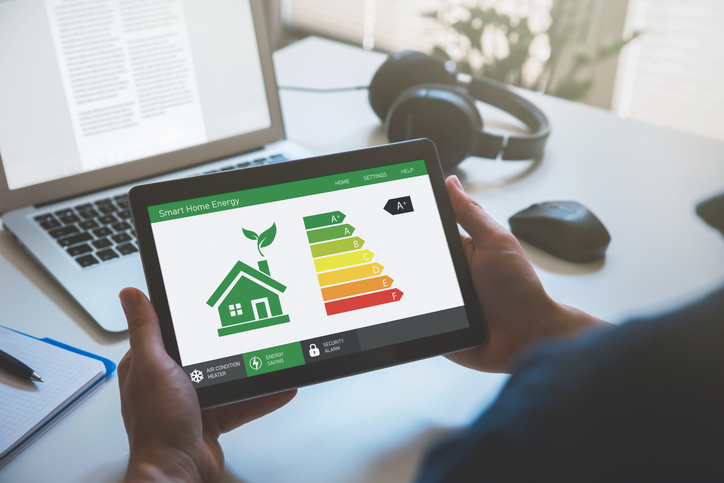
The energy label is a sticker affixed to the product that shows its energy rating using a scale of colors and letters, ranging from A (most efficient) to G (least efficient). However, the energy efficiency scale covers much more than that. It also applies to the construction and real estate sectors, covering parameters such as insulation and thermal efficiency.
The scale is based on a standardized guide in line with an international standard for classifying the type of building, appliance, or device and the range of energy demand to help consumers understand and manage household energy consumption within the family ecosystem.
Energy labels became widespread in the European market in 1994 as a means to promote energy efficiency in homes and companies and 95% of consumers now recognize the scale. Consumers take this rating into account when choosing their products, and it also drives the design of more energy-efficient products.
The current energy efficiency rating scale is governed by Regulation (EU) 2017/1369 of the European Parliament and of the Council of 4 July 2017 setting a framework for energy labeling and repealing Directive 2010/30/EU. In other words, it replaced the confusing old system of classes A+, A++, and A+++ with a simplified scale from A to G, which was implemented in 2021.
Seven levels from A to G
The new scale methodology is divided into seven levels based on the Energy Efficiency Index (EEI).
Class A and B (dark green and light green): These are reserved for products with cutting-edge technological innovations. When the system was first implemented, Class A was initially set aside to encourage future development. This means that very few appliances currently meet this efficiency standard because it was designed with an eye on the future, considering technical progress and sustainability features that could be incorporated in the medium term.
Classes C to E (yellow/orange): These represent the current standard for efficient manufacturing, and most products currently fall into these categories.
Classes F and G (orange/red): These identify appliances or buildings with the highest energy consumption per unit of performance. They consume the most energy and are being phased out of the market in favor of newer-generation models with eco-design features.
A direct QR code to the European Registry
There is also a European Product Registry for Energy Labeling (EPREL), which acts as a guarantee for consumers and can be accessed by scanning the QR code printed on a product. In Spain, it is supervised by the General Subdirectorate of Energy Efficiency and Access to Energy of the Ministry for Ecological Transition and the Demographic Challenge (MITECO).
This is a database containing information on all energy-labeled goods sold in the EU, designed to make it easier for consumers to access information on the energy efficiency of these products.
Evaluation criteria for buildings
In the real estate sector, the scale measures two key indicators set out in the Energy Performance Certificate (EPC). The adoption of Directive (EU) 2024/1275, known as the Energy Performance of Buildings Directive (EPBD), also marked a qualitative leap towards sustainability in construction, aiming for climate neutrality in the European building stock by 2050.
Factors such as thermal insulation (building envelope), the type of window frames, heating and cooling systems, and the use of renewable energy sources determine the building's ranking on the scale.
Finally, and according to data from the International Energy Agency (IEA) and the European Commission, the implementation of these scales not only provides households with financial benefits but also plays a fundamental role in national energy security by reducing the load on the grid during periods of peak demand.
Ultimately, the energy efficiency scale is like a small guide to help drive decarbonization in our homes by reducing consumption, optimizing resources, and improving efficiency.