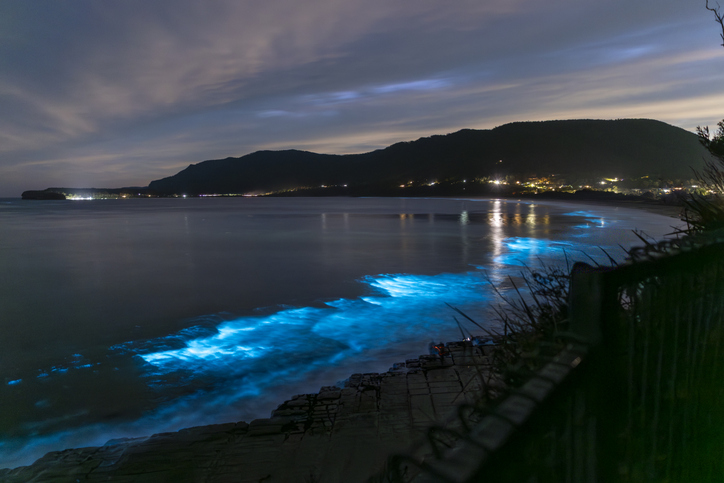
A fluorescent blanket of green and electric-blue flashes in whimsical shapes forms over the nighttime sea, giving it an unprecedented glow and light. This is marine bioluminescence. This phenomenon that seems straight out of a science fiction movie is, in reality, a curious environmental self-protection mechanism driven by millions of microorganisms working together to preserve their habitat.
Throughout history, sailors and coastal communities have viewed this phenomenon, which is known as the milky sea, with a mixture of mysticism and fear. It can be seen from the Costa da Morte and the Rías Baixas in the Spanish region of Galicia to the coast of Somalia, Indonesian islands in the Indian Ocean (where most are located), or the popular Mosquito Bay in Puerto Rico and the salt lagoons of Holbox in Mexico.
Although the bright light of the sea caught the attention of Jules Verne — who described the phenomenon in his classic novel Twenty Thousand Leagues Under the Sea — bioluminescence began to be rigorously documented in 1915. Today there are more than 200 bioluminescent seas that are recognized around the planet and visible from space.
A spectacle of cellular biochemistry
Oceanographic research has dissected this "magical" phenomenon to explain the chemical process that causes the sea to glow with its own light. In scientific terms, it is a spectacle of cellular biochemistry that occurs just below the water's surface and radiates upward, the result of a combination of geological, chemical, and biological factors interacting within the marine environment.
This occurs when millions of organisms invisible to the human eye transform the mechanical energy of the sea into visible light under certain environmental conditions, giving rise to one of the most striking visual phenomena in the oceans, like a miniature oceanic aurora borealis in electric blue and neon green. This phenomenon is not down to chance and has significant implications. It serves two biological needs for adaptation and survival among microorganisms: the flash confuses predators and also alerts the rest of the population, acting as a sort of "collective warning."
For light to appear, an ultra-fast biochemical reaction must occur within cellular structures called scintillons. When the physical movement of the sea — a wave breaking on the shore — deforms their membrane, channels open up that alter the cell's internal acidity. This change in pH immediately activates a catalytic enzyme called luciferase, whose sole purpose is to oxidize a fuel protein called luciferin. The result of this chemical oxidation is the instantaneous release of energy in the form of photons, creating a micro-flash that lasts just one-tenth of a second.
The spark of the sea
One of the key factors in the production of this fluorescent glow is the presence of bioluminescent microorganisms, particularly dinoflagellates (such as Noctiluca scintillans), which are tiny organisms that completely transform the nighttime landscape when they gather by the millions in bays and lagoons. Phytoplankton also plays a role in association with bioluminescent bacteria (such as Vibrio harveyi).
These organisms produce their own light through internal chemical reactions. The glow is triggered by geographical aspects such as the shape of the coastline and the underwater topography. Other influencing factors include the concentration of microorganisms, the "dance" of the winds, and ocean currents, elements that promote nutrient exchange in the water.
One of the most frequently asked questions is why marine bioluminescence is predominantly electric blue. The answer lies in the physical properties of light and water, as blue and green wavelengths travel much more efficiently and over greater distances through saltwater before being absorbed by the environment. In other words, marine organisms emit blue light as a group warning mechanism. It is the most effective way to ensure that their luminous message is seen across the vastness of the ocean, and therefore represents their natural defense and survival strategy against predators.
From Japan to Baja California
Therefore, bioluminescence is a temporary and variable phenomenon. Its occurrence and brightness can be affected by various factors, including water temperature, salinity, and seasonal changes. Consequently, observations of bioluminescence can vary from year to year, and even from season to season or continent to continent.
Generally speaking, it is more prevalent during New Moon nights and peaks during the summer months when water temperatures rise and the days are longer. These weather conditions, combined with the influx of nutrients such as phosphorus and nitrogen from rainfall or deep-water currents, cause phytoplankton to grow exponentially in an event known as an algal bloom.
Where can you see it? In Galicia (Spain), places like the Cíes and Ons Islands or the beaches of Carnota, Malpica, Fisterra, and Muxía on the Costa da Morte are known for their spectacular displays of this phenomenon. It can also be seen in the bays of Toyama (Japan), San Juanico (Baja California - Mexico), Halong (Vietnam), and D'Auger (Mauritius).
Ultimately, bioluminescent beaches remind us that some of the Earth's most breathtaking spectacles depend on the tiniest of creatures, natural balance, and the protection of our oceans to ensure that future generations can enjoy a sea that shines like the stars.