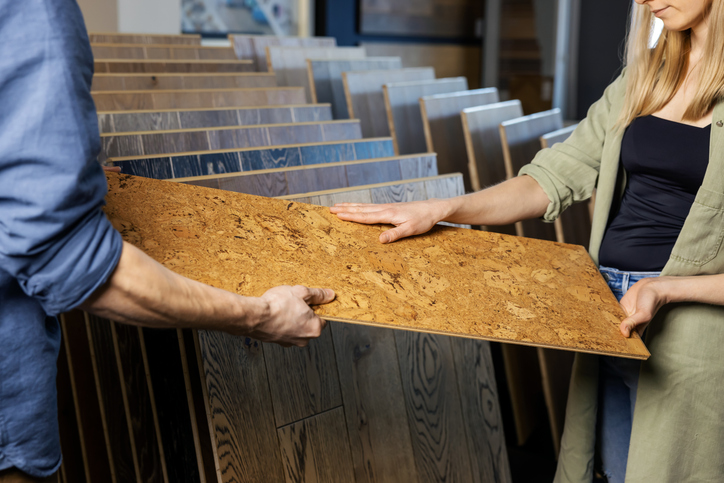
When you think of cork, the first thing that comes to mind is the popping sound of one being pulled out of a wine bottle. However, limiting this material to that single action would be merely scratching the surface. In fact, cork is one of the most versatile and strategic natural resources for moving toward a more sustainable production model. This is thanks not only to its technical properties but also to the way it is obtained, without cutting down trees or depleting the resource, and therefore without disrupting the balance of the ecosystem it comes from. Cork is harvested from cork oaks (Quercus suber) — characteristic in the Mediterranean landscape, primarily on the Iberian Peninsula — by stripping the bark off the tree.
Every nine or ten years, the tree naturally regenerates this outer layer. This means that the cork can be repeatedly harvested throughout its lifespan, which can exceed 150 years. Therefore, cork is a renewable resource with a production cycle based on continuity and respect for the forest's natural rhythm.
Tradition and international reach
Portugal is the world's leading cork producer, accounting for approximately 60% of the global supply. With the world's largest area of cork oak forests — more than 730,000 hectares — the country produces nearly 160,000 metric tons annually. These figures are not solely down to the abundance of resources, but also to the consolidation of a model that integrates sustainable forest management, biodiversity protection, and high-value-added industrial innovation. The Portuguese montados, as its cork oak forests are known, are based on a model that strikes a balance between the economy and conservation. Initiatives such as PortugalCork have boosted international visibility by promoting awareness campaigns, environmental certifications, and new applications in sectors such as construction, mobility, and design.
Spain is the second largest producer worldwide, according to data from ASECOR, the cork cluster. Its approximately 506,000 hectares of cork oaks (approximately 27% of the global total), which are mainly concentrated in Andalusia, Extremadura, and Catalonia, produce an annual harvest of around 80,000 tons, about a quarter of global production.
The Spanish sector brings together processing companies and remains strongly committed to innovation in the use of this material. Research efforts are also increasing thanks to projects such as ACICORK, which involves the CSIC (Spanish National Research Council) and has the objective of managing climate-smart cork oak forests.
One example in this field is Corkup, a Spanish company that develops reusable packaging and accessories for the hospitality industry and other sectors, thereby expanding the range of solutions based on this natural material. Many products made from cork can be recycled at the end of their useful life and turned into new raw materials, promoting more circular and efficient production models in line with the principles of sustainable design.
A material with multiple properties
Cork oaks provide a material that has unique properties for manufacturing products, as it is strong and lightweight, provides thermal and acoustic insulation, and is impervious to liquids, as well as being elastic and compressible, fire-resistant, and hypoallergenic.
This combination — which is difficult to replicate even in advanced synthetic materials — is due to its internal structure of millions of air-filled microcells that act as tiny natural insulating chambers. This microscopic architecture allows cork to absorb impacts and vibrations, return to its original shape after compression, and remain stable in the face of sudden temperature changes.
In the construction sector, it is used as insulation in facades, roofs, and floors, helping to improve the thermal and acoustic comfort of buildings. In transportation and aerospace, its lightweight and vibration-damping properties provide added value in advanced technical applications. Companies such as Amorim Cork Solutions have driven the development of solutions in fields as diverse as energy, mobility, and the aerospace industry. For example, it has been used in NASA space missions as a high-tech material as it is lightweight, has thermal and acoustic insulation properties, and is sustainable. And, above all, because of its ability to withstand temperatures exceeding 2,000°C in rockets such as the Falcon 9, Ariane 5, Atlas, Delta, and Vega.
On land, it is also used in the automotive industry to improve the aesthetics and comfort of doors, dashboards, and seats, as well as to reduce the weight of the flooring on high-speed trains or to cushion falls in playgrounds, to name but a few applications.
In this context, advances in processing technologies and research into new compounds are opening the door to as-yet-unexplored applications, especially in sectors that require lighter, stronger, and more efficient solutions. In this context, cork stands out not only because of its renewable origin, but also because of its technical performance. Thus, rather than merely an alternative, cork is a great solution.
Ultimately, this traditional material will play an important role in the future of circular and regenerative design to build a more sustainable world that respects the natural rhythm of the cork oak forests that produce it and their ecosystem.