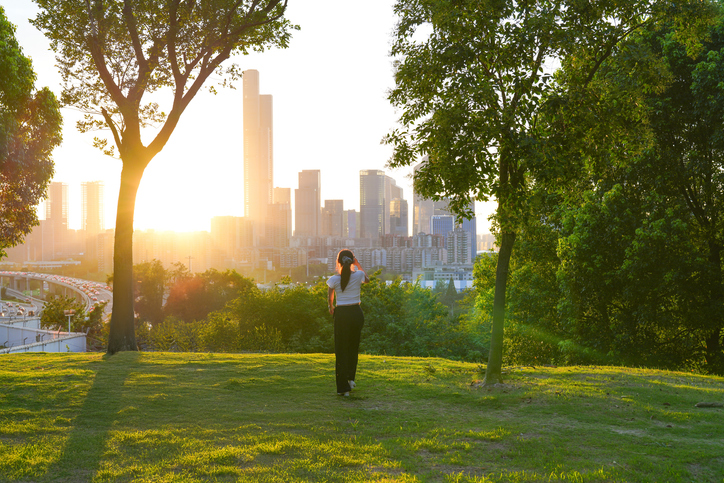
Regenerative urbanism is a new concept rooted in the planning and design of cities by going one step further than sustainable urban planning. While the latter seeks to reduce the impact that large cities can generate on the environment, regenerative urban planning aims to turn cities into platforms for positive change.
According to the report Urban Areas in Spain in 2025, prepared by the Ministry of Housing and Urban Agenda, 69% of the Spanish population resides in urban centers of more than 50,000 inhabitants.
This new city model is based on a series of pillars such as restoring ecosystems, creating a community among its neighbors through civic participation, and consolidating the circularity of its resources.
Innovations from the ground to the roof
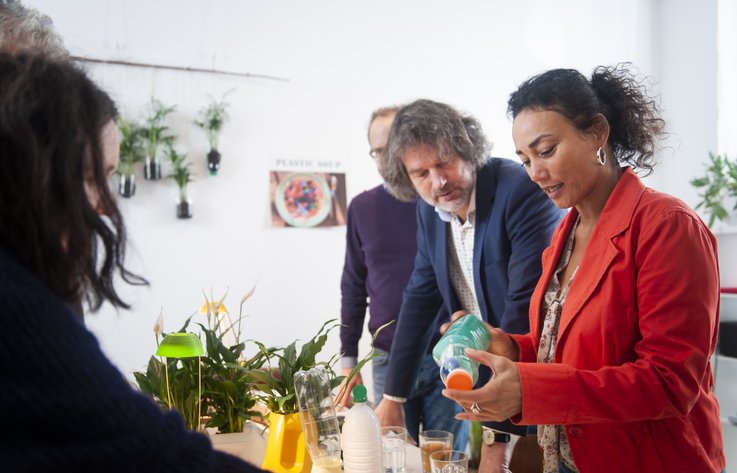
One of the premises of regenerative urban planning is the revitalization of urban centers as healthier spaces with more biodiversity. The active participation of inhabitants in decision-making to generate social cohesion and a sense of belonging is a key factor. One example of this is Santander, which in 2020 launched the #ParticipaPGS citizen consultation process to give voice to the specific needs of the population, with a view to planning the Santander, Future Habitat new city model.
Regeneration can come from construction itself, thanks to innovations such as pioneering concrete in the capture of CO2 from the air. In this regard, California-based Heirloom Carbon Technologies, together with the Canadian company CarbonCure, have succeeded for the first time in fixing carbon dioxide absorbed from the atmosphere to concrete, where it will remain trapped for centuries.
Designed by the Chinese landscape architect and urban planner Kongjian Yu at the beginning of the century, sponge cities also contribute to climate resilience, as they utilize the full potential of green infrastructures such as parks, permeable pavements, rain gardens, and green roofs to absorb, retain, and reuse rainwater, as if they were a sponge.
Among energy self-sufficiency solutions, science is immersed in the development of new materials capable of capturing more solar energy. Among them, perovskite is perhaps the most innovative element, since, in addition to achieving efficiencies above 27%, its flexibility and thickness allow it to be easily integrated into roofs, windows, and facades to generate more energy.
Reference cities in Spain
Bilbao was the most representative case of Spain's transformation from industry to the cutting edge, with the recovery of the estuary, the restoration of the old town, and a boost to the communications system. A path that remains relevant today, with the regeneration of some of its neighborhoods such as Zorrotzaurre.
The asphalt, concrete, and industrial landscape that characterizes the streets of the Cantabrian city of Torrelavega has also begun to transform, thanks to the Torrelavega Natural Corridor project, promoted by its city council and financed with two million euros of European funds. The plan includes measures such as the installation of more than 300 nests and shelters for birds and bats, the creation of microgardens for pollinators, and the distribution of ponds at various points in the city to generate biodiversity.
The wave of transformation is weeping across Spain from north to south. Thus, Seville has launched the 2025-2029 Pítamo Sustainable City, which covers 200 hectares and with plans for the construction of 9,910 homes (4,200 subsidized) near the Guadaira river. This "low-density residential" area promises to reduce mobility flow with the implementation of an "environmental island model", in which all services converge, restoring a human scale and proximity. To this end, its planning and design, with the preservation of natural and river areas, seeks to reorganize public spaces to prioritize pedestrians, improve sustainable mobility, and increase environmental sustainability.
Other examples: from Hamburg to Tengah
- Hamburg and HafenCity: from an unused port to a modern, sustainable, and integrated neighborhood. This is HafenCity, the most ambitious conversion project in Europe, initiated in 2002. Around 7,500 homes coexist with stores, cultural spaces, and cutting-edge architecture, including the Hamburg Philharmonic. An example of urban resilience that is transforming Germany's second largest city.
- The "forest city" of Tengah: nicknamed the "forest city", Tengah begins to project its future as Singapore's first eco-intelligent city, composed of five districts on 700 hectares. An urban center where mobility prioritizes bicycles and public transport; the application of smart technology to homes to improve their energy efficiency, and a forest corridor of 31 hectares to enhance biodiversity will be the pillars of this city of the future.
- Sydney: the Australian capital has developed a Climate Adaptation Strategy. This urban renaturalization plan aims to plant thousands of trees to ensure that 40% of the capital's metropolitan area is covered with vegetation by 2050.
- Medellín and its green corridors: the second largest city in Colombia launched the "green corridors" program in 2016 in order to use nature to reduce heat and promote the decarbonization of the city. The system has 26 green corridors, with more than 92,000 square meters of gardens distributed throughout the city. In 2025 alone, more than 21,800 garden plants and more than 160 trees and palms were planted.
These are just a few of the success stories from around the world that show how cities are transforming their urban centers to respond to environmental, economic, and social challenges, with the idea of generating a positive footprint in the environment to build a more livable future for the entire population.