Over the past decade, the EU’s energy strategy has been guided by one key metric: the installation of megawatts. The more wind and solar farms — or other renewable power plants — that became operational, the closer it came to its goal of becoming the first region to have a decarbonized economy. Eleven years after the Paris Agreement, it is clear that this approach has succeeded.
However, Europe has seen that producing electricity from renewable sources is only the first step in a race to boost productivity and gain a competitive edge over the U.S. and China. Similarly, it has come to realize that this challenge should be a top priority on European institutional and business agendas if it wants to ensure that energy reaches the most remote and appropriate locations at exactly the right time. And when there is a surplus of electricity in the grid, it should be converted into other forms of energy.
The statistics confirm this paradigm shift. According to the 2026 edition of Energy in Europe by Eurostat, renewables accounted for 48% of the internal market's energy in 2024, the most recent year for which data is available. At that time, electricity from renewable sources reached 48%, compared to 28% from fossil fuels and 23% from nuclear power. Wind power accounted for 17% of Europe’s electricity, hydropower for 13%, and solar power for 11%.
Therefore, the shift toward renewable energy was already noticeable two years ago. At the start of the century, renewables accounted for barely one-tenth of the EU’s gross energy consumption, but two decades later, they now account for about one-quarter. Europe has met a growing portion of its energy demand and supply with its own resources, without relying on imports. And when we focus on the electricity mix, data from the first half of 2026 paints an even brighter picture.
Europe obtained more than half of its electricity from renewable sources, reaching 54.1% according to Eurostat, which also ranks Spain as one of the most promising member states with a figure nearing 60%. The exact figure is 59.5%, according to data from Redeia, the Spanish electricity grid.
Chart 1. Comparison of the electricity mix in the EU and Spain, second quarter of 2026.
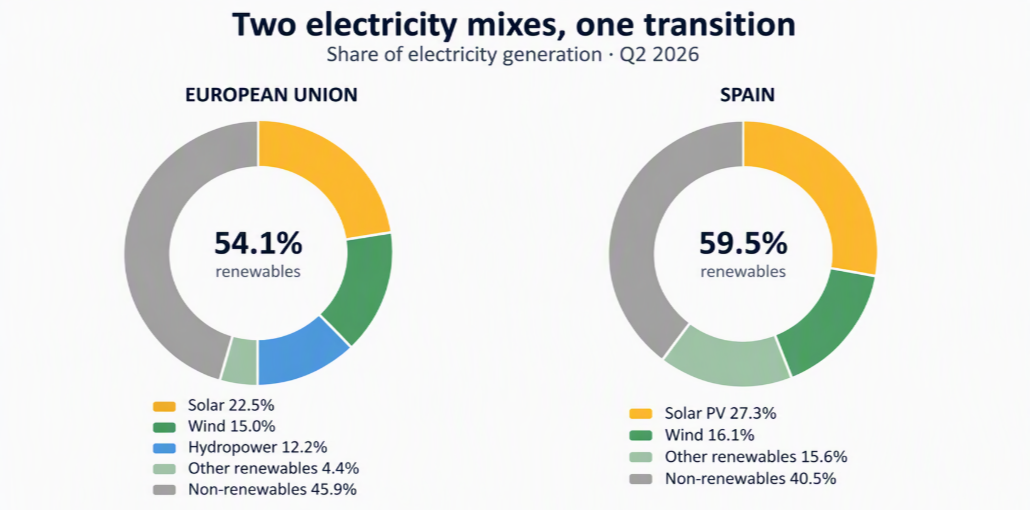
Source: author´s own elaboration based on data from Eurostat (EU) and Red Eléctrica de España (Spain). Spain: Q2 calculation based on April, May and June data; estimated self-consumption not included.
In 2024, the EU produced 43% of the energy it consumed within its borders and relied on net imports for the remaining 57%. Fossil fuels still accounted for 38% of the energy mix, while natural gas represented 21% and renewables 20%. This difference is, if anything, even more telling if we consider one of the bottlenecks: while the continent has an increasingly decarbonized electricity grid, it coexists with cars, industrial furnaces, airplanes, ships, and chemical processes that are still heavily reliant on imported fossil fuels.
That is why the transition is no longer just a climate issue, and why the formula for success also involves factors such as productivity and strategic autonomy.
Energy security: today's challenge
Security has taken center stage on the European energy agenda. The current challenge must revolve around the ability to efficiently store, connect, and transform or distribute all of its abundant renewable energy. Or, to put it another way, Europe must urgently equip its infrastructure network, which has no shortage of renewable energy capacity, with the flexibility to transform this energy.
This unresolved problem rears its head every day at noon. On sunny days, thousands of solar power systems generate electricity in unison. Sometimes, they produce so much electricity that the grids cannot transport it to where it is needed, and a portion of the potentially available energy is wasted. It is as if solar power had fallen victim to its own success and was beginning to cause bottlenecks in the grid.
This is where experts emphasize the importance of batteries. Their role may seem modest, but they transform the system. They store inexpensive solar power at midday and feed it back into the grid when the sun goes down, absorb excess power, respond to imbalances within seconds, and make the grid more flexible.
In a system that includes several variable sources, value does not just reside in producing kilowatt-hours at a low cost, but also in deciding when to use them.
Antonio Arruebo from SolarPower Europe highlights the case of Romania, a country where storage capacity is being developed across the grid in the early stages of solar expansion, rather than attempting to incorporate it once the grid has reached capacity. Its solar capacity grew by 45% in 2025, and by the first half of 2026, about one-third of its nearly 330,000 prosumers — users who generate, consume, store, and share or sell their own electricity — had already installed batteries.
However, batteries are not enough. Grids are the circulatory system of European electrification, and many of them were designed for a different type of energy ecosystem with large power plants serving predictable consumers. In contrast, our electricity systems now integrate millions of solar panels, wind farms, batteries, electric vehicles, heat pumps, and digital devices that produce and consume energy in a much more dynamic way.
Izabela Surwillo and Julia Schwab, authors of the study from TEPSA, a pan-European think tank, describe a post-pandemic Europe that is more resilient, but still exposed to systemic risks, particularly in term of its dependence on Russian gas.
Interconnections would resolve this uncertainty because a better-connected system would be able to send surplus solar power from one region to another with lower production. In addition, it would also make it possible to share reserves and better harness the complementary nature of wind, solar, and hydropower and demand.
When an electron is not enough: the impact of molecules
In this push to modernize infrastructure, there is a physical limit that no smart grid can overcome. It is impossible to electrify the entire economy. Replacing fossil fuel molecules with electricity is efficient in the case of cars, heat pumps, or many industrial processes, but for aviation, maritime transport, parts of the heavy haulage sector, or certain manufacturing chains that require high temperatures, the solution is more complex.
This is where green molecules, including renewable hydrogen and its derivatives, biomethane, and second-generation biofuels, must take center stage. They are not an alternative to electrification, but rather a complementary measure. They make it possible to use renewable energy when electricity alone is not enough.
The International Energy Agency (IEA) has urged countries to diversify energy supplies with molecules. This can have an even greater impact when these molecules are produced using electrolysis with domestically produced renewable energy. The challenge is to scale up production, reduce costs, and align consumption demand with adequate infrastructure. Peter Zeniewski, an energy analyst at the IEA, highlights the potential of biogases to combine energy security with low emissions and local economic activity.
The report Why does Europe need green molecules? by Moeve and PwC estimates that the development of green molecules would help reduce European energy dependence by half, from 57% in 2024 to 28% in 2040, and replace up to 50% of the current fossil fuel demand by 2050. If renewable electricity is the backbone of the new system, green molecules would be the industrial muscle.
In this regard, Spain is as a good testing ground thanks to its solar and wind resources that are virtually unmatched in Europe. This abundance has helped optimize costs and placed the country in a leading position in terms of the 2030 Goals. However, as a result of this abundance, the limits of a model based primarily on continuing to add generation capacity have become clear here sooner than in other parts of the world.
The other vulnerability is the grid. Spain has planned to invest more than 17 billion euros in electric grids by the end of the decade. But the issue is not just about building more lines. A digitized and flexible grid must be able to manage distributed generation, future industrial consumption, data centers, self-consumption, electric vehicles, and storage, in addition to strengthening interconnections with the rest of Europe.
Therefore, the goal is to avoid wasting large-scale renewable energy sources and have a grid that is capable of withstanding stress tests; a grid through which electrons flow, with batteries for temporary storage, national interconnections, and green molecules that carry their productive value to places where direct electrification is not possible, thereby generating sustainable energy and fueling a competitive industry.