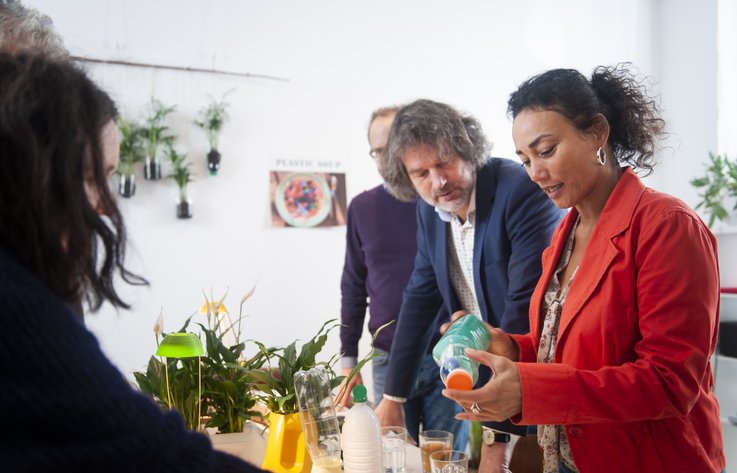
Upcycling, also known as creative reuse or supracycling, has become a key tool for transforming obsolete products into useful, higher-value ones without the need for chemical breakdown or complex procedures. This reduces the environmental footprint by eliminating the need to inject new energy into the production cycle.
The term was originally coined in 1994 by German engineer Reiner Pilz. It was intended to contrast with downcycling, a traditional method in which materials lose quality and value with each reuse, due to the multiple steps involved. It essentially aims to maximize the use of by-products to create new, higher-quality materials while avoiding industrial processes that could damage the original structure of the object.
Years later, the concept became popular worldwide thanks to the book Cradle to Cradle: Remaking the Way We Make Things by William McDonough and Michael Braungart. This foundational text laid the groundwork for modern ecodesign based on a circular model.
"Upcycling" in the wind revolution
In what ways has it influenced renewable energy? Perhaps the best example is the dismantling of obsolete wind farms. Wind turbine blades are made of thermostatic resins and fiberglass, which are highly resistant materials originally designed to never degrade due to wind friction.
Rather than crushing them through mechanical processes, companies like the Irish firm BladeBridge cut them longitudinally to immediately use them as high-load-capacity beams in pedestrian bridges. The Dutch firm BladeMade, for its part, takes advantage of these structures' aerodynamics to integrate them directly into the urban environment in the form of highly resistant playground equipment and public furniture.
Technical reuse in the energy sector is also taking place at former solar farms; that is, photovoltaic installations for solar power generation that had become obsolete. Industrial innovation in this segment involves isolating the high-purity silicon wafers and silver filaments embedded in the photovoltaic panels without breaking the module's glass structure.
It allows us to reintroduce these minerals directly into the fabrication of new-generation solar cells, eliminating the need for primary mining.
From fibers for footwear to coffee grounds for cosmetics
There are two pioneering sectors in industrial upcycling: textiles and footwear. These sectors have adapted the principles of circularity for years to reuse fibers and make their processes more sustainable.
The Swiss brand Freitag was one of the first to apply modern commercial upcycling in the fashion and accessories sector, with backpacks made from old truck tarps.
The shoe manufacturing industry is no exception. Some brands have already created synergies with the land transport sector to incorporate upcycling. Defective seat belts, tarps from out-of-use fire hoses, and rubber and tires from wheels are used to make the soles of sneakers. The soles are laser-cut to produce the outer profiles.
The circular structure of the footwear is completed by introducing high-performance biodegradable materials. Manufacturing workshops recover cotton yarns and leftover fabrics, such as boat sails, airplane carpets, and wetsuit neoprene, which are braided to shape the high-resistance, technical mountain sneakers without growing new fiber from boat sails. This is another example of how waste can be transformed into a valuable resource with the right design.
Lastly, the cosmetics industry has also jumped on this trend in a movement called Upcycled Beauty, which synthesizes active beauty ingredients from by-products of the food industry. How? Specialized laboratories collect tons of coffee grounds from urban coffee shops; through cold pressing systems they extract a concentrated oil rich in caffeine, caffeic acid, and antioxidant compounds that serves as the base for anti-aging serum and eye contour cream formulations.
Raspberry seeds, olive pits from oil mills, and nut shells from packaging plants are ground in a controlled manner until they reach an ideal size for the skin (micronization). Similarly, foods rejected for commercial sale due to size, over-ripeness, or physical defects can be valuable resources for the cosmetics industry. Brands like Acure and GSKIN use upcycled avocado oil purchased from suppliers such as Expanscience.
Ultimately, industrial upcycling represents a paradigm shift in which the traditional concept of waste is replaced by a new concept within the roadmap toward a circular economy. Efficient and intelligent utilization through synergies between sectors will be key to decarbonization.