

A wind and landscape with an aroma of ham
Calamocha, the nerve center of the Jiloca region, evokes the crossroads of cultures from its name, which is of Muslim origin. Witness to the passage of Romans, Arabs, conquerors, and merchants, it is today shaped by those same winds that have produced one of the Peninsula’s best hams for over eight centuries: Teruel ham. We walk from Calamocha to El Poyo del Cid following the winds, landscape, and altitude that has shaped a people who produce great products from the land: ham, truffles and saffron.
What can we find?
- Twelve kilometers of trail in agricultural surroundings of farmland, following the course of the Jiloca River upstream, with walnut trees and wetlands.
- Medieval remains of Roman origin.
- Old copper hammer mill and wool wash house.
- 16th-century Church of the Assumption of Our Lady.
- Nature trail following the route of the old railway line.
- Gallocanta Lagoon.
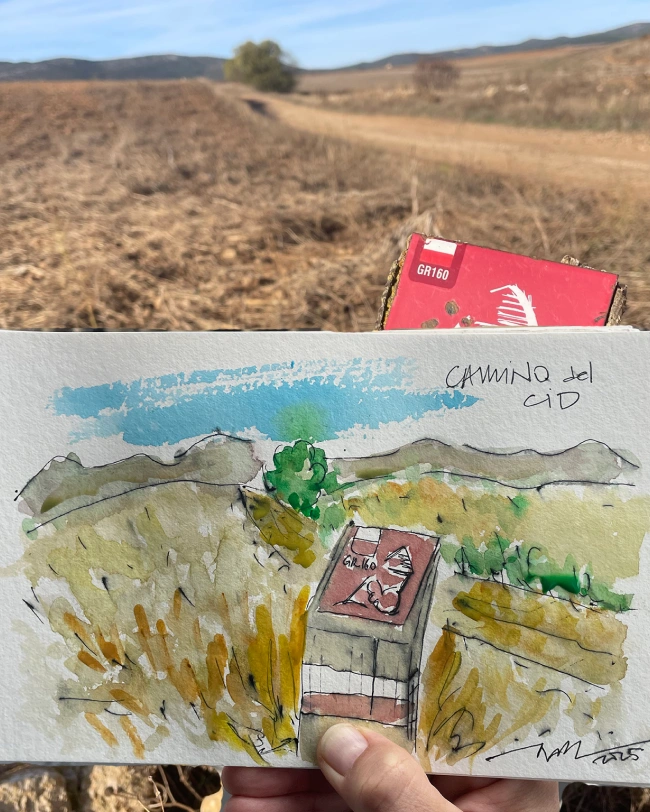
- Camino del Cid, a long-distance route.
Voices from the “Camino”
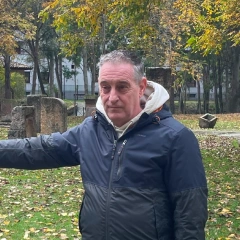
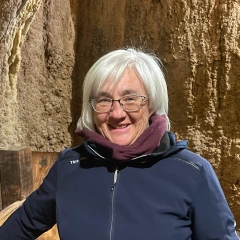
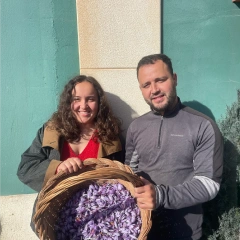

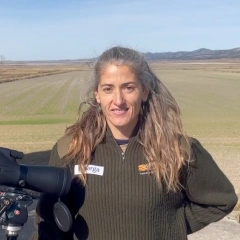
Preparing for the Trail
location
Circular - 12 kilometers - 3 hours on foot
uniform
Wear suitable shoes and clothing
bird
Wetlands and migratory birds
visibility-on
Medieval remains
The path between Calamocha and El Poyo del Cid shows us traces of a glorious trading past with bronze mines and wool, a landscape that the Cid knew how to appreciate and enjoy, and an agricultural and gastronomic present that invites us to dream of a future where travelers also traverse this path with their palate through its ham, wine, cheese, and saffron.
Section 1 – Departure from Calamocha near the waterwheel and the washhouse
The path begins after leaving behind the Church of the Assumption of Our Lady, crossing the medieval bridge of Roman origin, and passing very close to a mansion with a copper hammer mill and the wool wash house, which were the driving forces behind Calamocha for years as they were located on the wool and mineral trade routes.
Section 2 - Former railway line among walnut trees and hundreds of birds
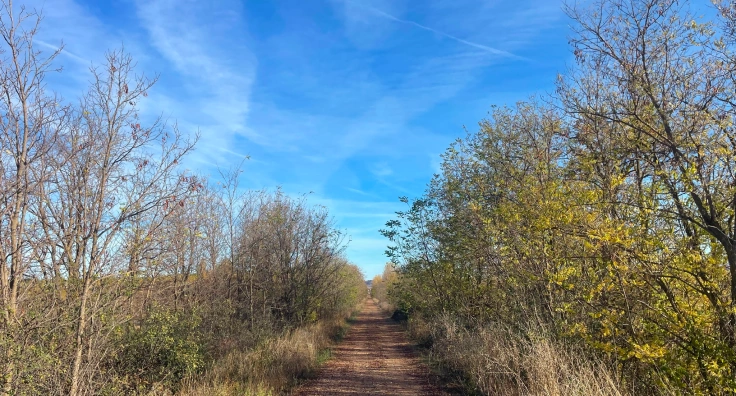
The route follows a nature trail that was previously used by the train connecting Santander with the Mediterranean. The rattling has now given way to a musical accompaniment of the songs of hundreds of different birds and the sound of the wind blowing through the groves of poplar and walnut trees. Those moments of silence alone make the hike worthwhile.
Section 3 – Arrival at El Poyo del Cid
About 5.7 kilometers away, we arrive at El Poyo del Cid, the place where Cid Campeador camped with his troops. Specifically, on the hill that protects the village from the wind and from where you can see the entire plain. Many also navigate this path by bike and with saddlebags. The Camino del Cid brings to life one of the longest routes of the Iberian Peninsula with 7 stages and 1,500 kilometers, the dream of every amateur cyclist.
Section 4 – We return by the Camino del Cid
At this point, you can continue straight to Monreal del Campo, with a must-visit to the 18th-century church of San Pedro and the saffron museum.
Or you can return to Calamocha via the old railway nature trail and treat your taste buds to a well-deserved dinner at one of the many local restaurants, terraces, and gardens, enjoying the aromas brought by this climate and the northwesterly winds: Teruel ham, Jiloca wines and cheeses (Tronchón, El Aljibe, Sardón, La Val, Remei). An excellent plan in which ends with spending the night in Calamocha.
Map and route
Sounds of the land
00:00
00:00
00:00
El Camino del Jiloca: what to see and where to go
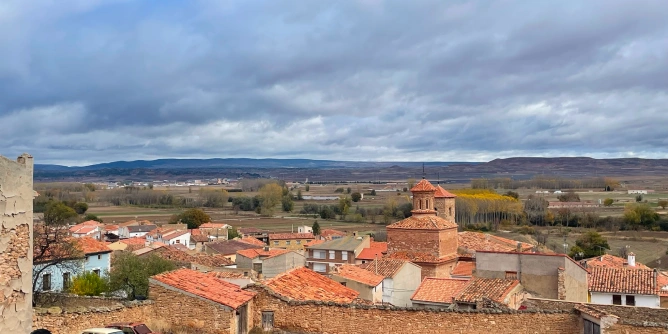
The start of the path among walnut trees and crop fields
Calamocha (Teruel) has always been a great crossroads. Here settled Romans and Arabs, merchants and conquerors, multinationals and entrepreneurs, both for its geostrategic value and for the wealth of its rivers and landscapes. To walk its trails is to understand its history and connect with a vibrant future, where the towns of the famous “Spanish Lapland” are reborn thanks to the northwesterly winds, the altitude, and a dry atmosphere that allows us to enjoy the famous Teruel ham (D.O.). Along 12 kilometers, from Calamocha to Poyo del Cid, we can see all the potential it has to welcome back restless and curious travelers, lovers of good food and wide open landscapes.
The trail begins after passing the 16th-century Church of the Assumption of Our Lady, built on the site of an ancient medieval castle and magnificent tower. Cross the medieval bridge of Roman origin and pass in front of the old copper hammer mill and wool wash house. The Roman bridge dates back to the first century and tells the story of the Via Augusta, the road connecting Zaragoza with Jaén. The copper hammer mill was started up by a French merchant back in 1689, who recognized the power of the river as a basic resource for working the bronze from nearby mines. The same was true for the wool wash house that would help lighten the weight of the wool brought from the Sierra de Albarracín towards the trade routes, now clean and without extra weight, that crossed the Peninsula.
All these elements speak of the importance of this same path throughout the region of the Jiloca River. We walk among walnut trees, vast crop fields, and autumn light that brings out the explosion of ochre colors. Hues that will accompany us during these six hours of a pleasant walk.
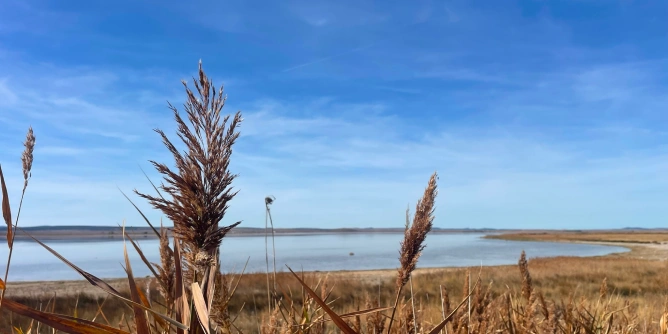
A privileged land for growing crops that captivate the palate
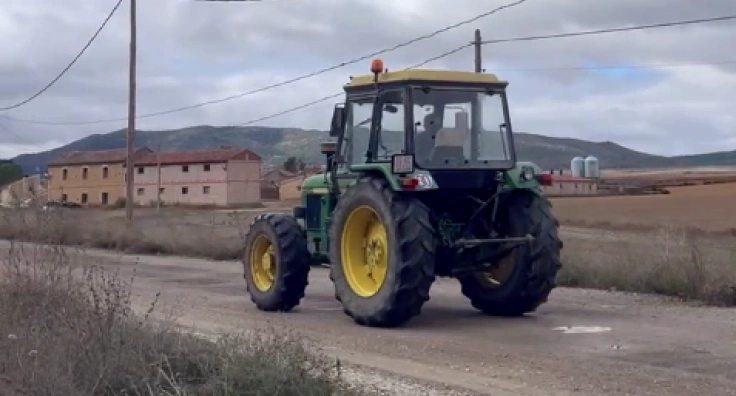
Today silence prevails along the entire path, with the echo of these stories. A silence broken at times by the wind, accompanied by the singing of hundreds of birds sheltering in every tree along the way and the warm greetings of people walking through the different villages that dot the route, such as Poyo del Cid and Fuentes Claras, Caminreal… And we will almost see more tractors in motion than people. Of course, from time to time, a group of cyclists will pass us at high speed, and the murmur of the Jiloca River will always serve as our compass.
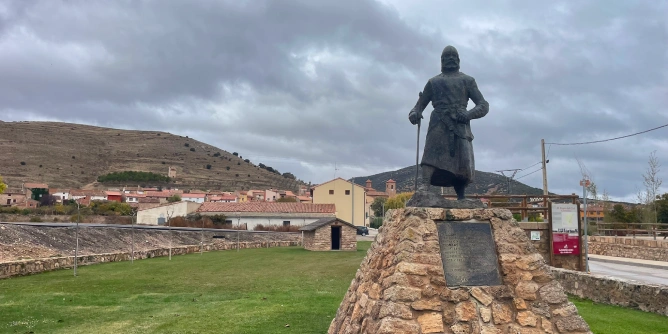
A mandatory stop to pay tribute to Díaz de Vivar
After 5 kilometers, you will reach Poyo del Cid, where the nature trail of the old railway that connected Santander with the Mediterranean can also be taken. A hill stands out in the plains of crop fields. And on that hill, Rodrigo Díaz de Vivar, or Cid Campeador, the famous medieval knight of the 11th century, decided to camp; we now walk along a path that pays tribute to his life from Burgos to Alicante through eight provinces and seven sections.
El Cid took that hill as his headquarters along with more than 7,000 men, as mentioned in the Song of El Cid, the great work of medieval literature that, between fiction and reality, recounts the life of this nobleman, a mercenary who experienced both glory and the hardship of exile. Today, a stone figure commemorates his presence in the area; the town itself is nestled at the foot of the same hill, as if seeking shelter from the cold northwest winds that whip across this plain.
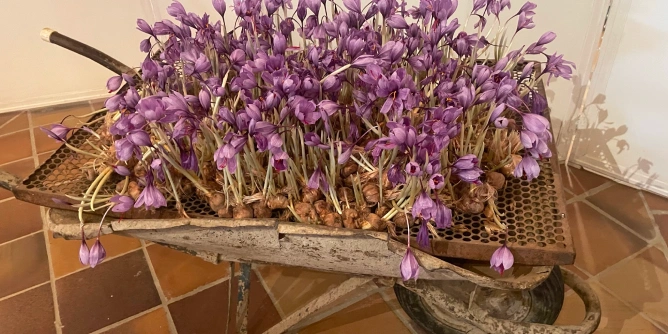
Land of ham, of saffron … and of cranes
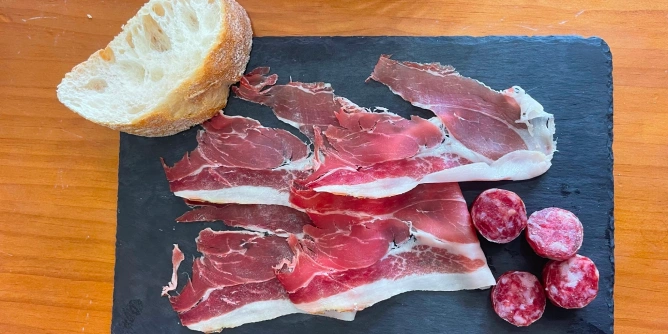
At this point we return to Calamocha again. The route along the Camino del Cid, the return on the nature trail, and now, a recreation of those views with the palate: Jiloca saffron, Teruel ham, and other flavors typical of Monreal, Caminreal, Calamocha, and the entire region.
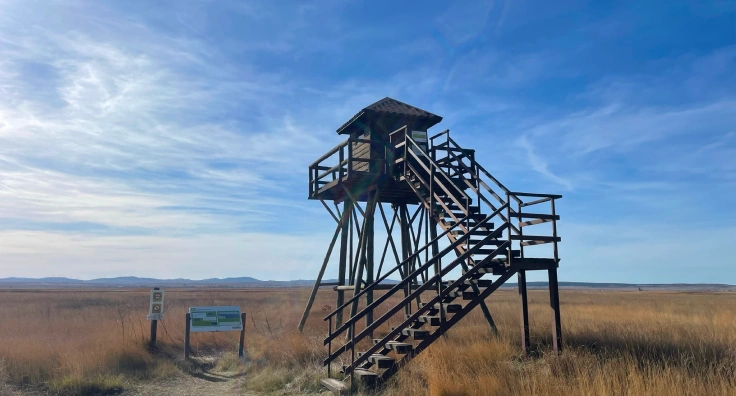
However, many continue on to Monreal del Campo, completing a six-hour route in a straight line. But to make your visit to the area complete, the next day it is worth taking a leisurely trip to the Laguna de Gallocanta, a sanctuary for thousands of migratory birds, including cranes. An internationally renowned spot for birdwatching and the most important and best-preserved salt marsh in Europe.
Must-sees in Calamocha and its region
- August 16: San Roque. In Calamocha, not only is this "celebrated"; a promise is fulfilled. Since 1886, about 200 couples (in white and blue sashes) accompany the saint dancing from Santa María la Mayor to the hermitage. And when someone wants to recite a "saying", the stick is raised and everyone falls silent. A tradition that has been declared a Festival of Tourist Interest of Aragon (2012).
- Pilgrimages and Holy Week: a week of silence where the sound of trumpets and drums can be appreciated.
- Summer festivals in the neighborhoods of Santo Cristo, Santa Orosia, Pollo del Cid, and Calamocha.
- September 6, Patron Saint's Day in Monreal del Campo.
Discover the rest of the routes

Moeve in the region
We shape the future by driving initiatives in communities to connect people and opportunities.