
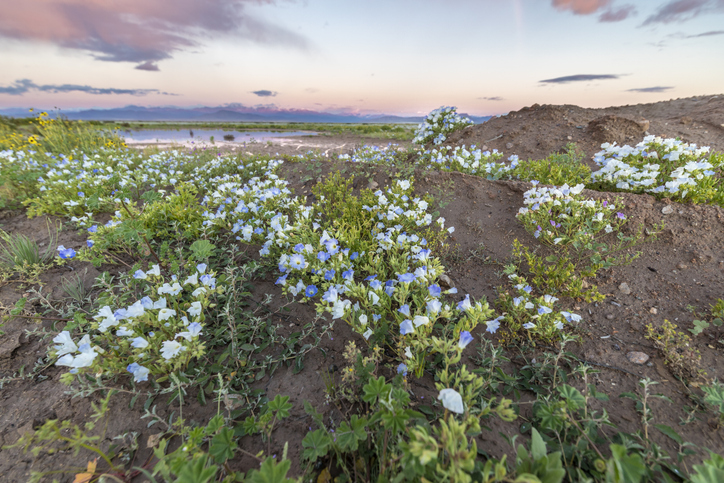
Deserts are often associated with a lack of water, extreme temperatures, and low biodiversity. However, beneath their barren appearance lies an extraordinary capacity for adaptation. Under certain conditions, these ecosystems undergo a radical transformation, giving rise to landscapes blanketed by thousands of flowers that bloom almost simultaneously and completely change the appearance of the environment. These phenomena are known as desert blooms or superblooms.
How does this happen? The key lies in seeds that can survive buried in extremely dry soil for long periods of time. When the right moisture and temperature conditions coincide, these seeds germinate almost simultaneously and give rise to fleeting blooms that transform the landscape. We can find this phenomenon in different parts of the world, such as the Atacama Desert in Chile, the Anza-Borrego Desert in California (USA), or in the Kalahari Desert in Northern Cape (South Africa).
A similar, albeit less common phenomenon has also been documented in the Sahara Desert. In 2024, NASA satellite images showed green patches across large areas of northwest Africa following heavy rains caused by an extratropical cyclone.
This significantly increased soil moisture levels in countries such as Morocco, Algeria, Tunisia, and Libya. Although the Sahara is now one of the driest deserts on the planet, some 6,000 years ago it was a much wetter and more fertile region, which explains the ecosystem's residual capacity to respond to such weather events.
An explosion of color
One of the world's most spectacular and well-known blooms occurs in Chile's Atacama Desert, which is known as the Desierto Florido, or Flowering Desert. Despite being one of the driest places on Earth, this desert is sometimes blanketed with flowers during spring if winter rains have been particularly abundant. Some species of dormant seeds require at least 15 mm of rainfall in a year to germinate.
Many of the species that grow are endemic and remain hidden for years as seeds. Their flowering period is short-lived, lasting only a few months, and they re-emerge the following winter if the right weather conditions are present.
The color palette of the desert
However, this process doesn't just affect plants. It also triggers a chain reaction in the ecosystem that leads to the appearance of rodents, predators, and pollinators.
The color of the flowers also plays a key role in the process. In an environment where breeding opportunities are scarce and fleeting, flowers have vivid colors to attract pollinators.
A study of species found in the Atacama Desert, such as Cistanthe longiscapa, highlights the high chromatic variability of flowers growing in very small areas. This diversity of color, which does not appear to depend solely on environmental factors, could constitute an evolutionary advantage in extreme desert conditions by promoting cross-pollination and expanding interactions between plants and pollinators during these short-lived episodes.
The ecological and scientific significance of this phenomenon led Chile to establish the Desierto Florido National Park in 2023. Covering an area of more than 57,000 hectares, this park protects a one-of-a-kind desert Mediterranean scrub ecosystem. In addition to conserving numerous endemic plant species, the park serves as a natural laboratory for studying ecological dynamics with the aim of strengthening conservation strategies.
Thus, desert blooms remind us that, even in places that seem hostile, nature can still surprise us, adapt, and be reborn when the right conditions are present.