

What is green ammonia and what is it used for?
Green ammonia is a product derived from green hydrogen that can be used as a sustainable marine fuel and as a carrier of green hydrogen for transport. Both its production, combining green hydrogen and nitrogen from the atmosphere, and its use as a fuel are carbon neutral.
Ammonia is easier to transport than hydrogen because it does not need to be stored at such low temperatures and because ships and infrastructure dedicated to its transport have been in place for decades.
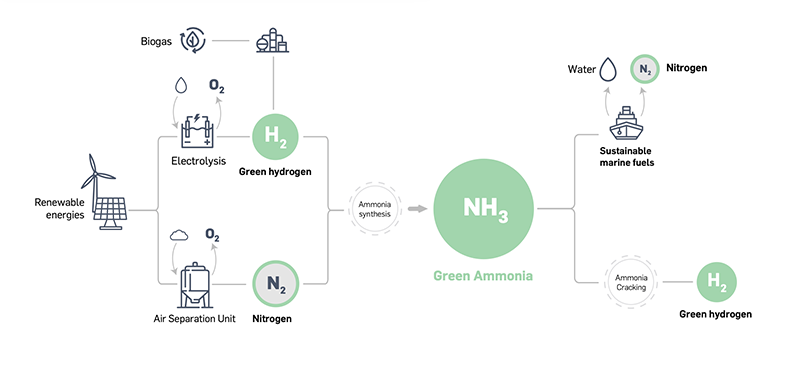
Once at its destination, green ammonia can be converted back into green hydrogen for use in multiple industries in northern Europe, or it can be used directly as fuel in maritime transport or in certain industries, such as fertilizer production.
Our project: Europe's largest green ammonia plant
As part of the Andalusian Green Hydrogen Valley, we have established a partnership with Yara Clean Ammonia that will enable us to build Europe's largest green ammonia plant in the San Roque energy park in Cadiz. With an investment of €1 billion, the plant will have an annual production capacity of up to 750,000 tons of ammonia and will prevent the emission of 3 million tons of CO2.
It will be operational in 2027 and its construction will create 3,300 jobs, including direct, indirect, and induced employment.
This strategic agreement will make it possible to establish a secure, resilient, and efficient supply chain for green ammonia, and will allow us to start marketing green hydrogen and ammonia to industrial and maritime customers in Rotterdam and its catchment area, as well as other destinations in northwestern Europe.
How? Thanks to the agreement with the Port of Rotterdam to create the first green hydrogen corridor linking southern and northern Europe, connecting the ports of Algeciras and Rotterdam.
This is what the green hydrogen maritime corridor will look like
How is green ammonia produced?
Green ammonia is produced using a process that is fundamentally different and much more sustainable than traditional ammonia. The key lies in the energy source and materials. First, electricity generated exclusively from renewable energy sources, such as solar or wind, is used to split water into hydrogen and oxygen (a process called electrolysis). Once we have that ‘green’ hydrogen, it is combined with nitrogen, which is obtained directly from the air. This combination, which occurs under certain pressure and temperature conditions, results in green ammonia.
Find out more about green hydrogen
Our alliances for green hydrogen production
To drive the entire hydrogen value chain, we have established strategic alliances with local, national, and international partners.
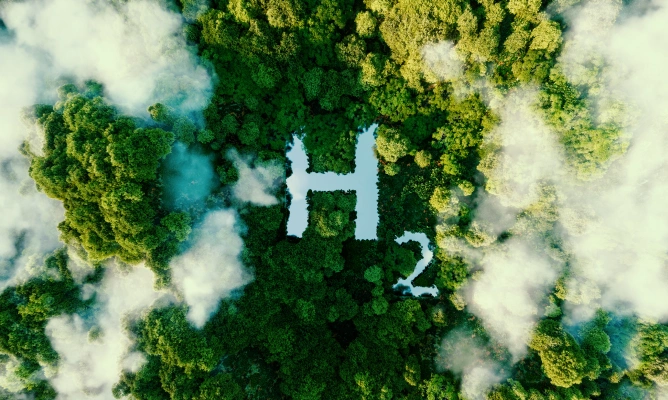
Andalusian Green Hydrogen Valley
A project that reinforces the Andalusian Green Hydrogen Valley, the largest hydrogen project presented to date in Europe.
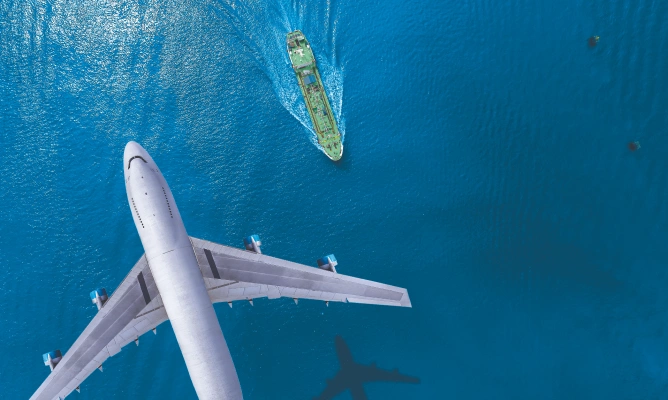
Methanol
A solution for decarbonizing maritime and air transport and the chemical industry.