Exists, works and is sustainable. District heating consists in an energy system where heat is produced centrally and distributed to multiple buildings—residential, public, offices, and so forth—through a network of underground isolated pipes that transport hot water or steam.
What is the goal? Provide heating and domestic hot water efficiently and sustainably, as, unlike individual and domestic systems, it eliminates the need for boilers in each building and increases overall energy efficiency.
District heating has multiple energy sources. It can be powered by water, geothermal energy—which emanates from the earth—or biomass, and even, in the most advanced and innovative proposals, it harnesses and uses the residual heat generated in industrial processes or waste incineration plants to heat public buildings such as hospitals, train stations, and social institutions.
For example, once the water has been used for heating, it returns cold to the plant to be reheated in a closed circuit that does not waste a single drop of this essential resource.
From Copenhagen to Seoul
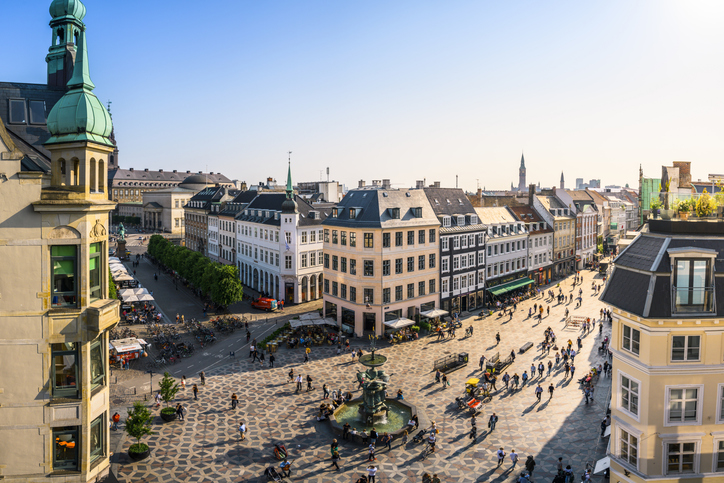
Denmark is the country with the greatest advantage in this area. Especially in its capital, Copenhagen, with 90% of the city connected to the network of one of the systems that are considered an example of energy efficiency and that began testing in the 1970s.
In general, Nordic countries have devoted the most resources to developing their district heating networks, with excellent results based on the availability and prevalence of their natural resources. In Stockholm, Sweden, they opt for heat pumps that use seawater, while Iceland takes advantage of its volcanic terrain to obtain geothermal energy, which is then used as the main source of energy for its district heating system to heat facilities in Reykjavik.
Meanwhile, in Helsinki, Finland, there is more widespread use of waste heat recovery from industrial processes, while in Austria, they opt to use the heat released from large urban incinerators to heat some buildings in Vienna.
It is worth mentioning that district heating is not exclusive heritage of Europe. New York has one of the largest and oldest urban steam systems in the world, while Toronto, Canada, boasts a district power system that uses water from its lakes to heat and cool. For its part, China is also making progress with steam systems that are already implemented in Beijing and other northern cities. The capital of South Korea, Seoul, uses it in the most populated neighborhoods.
Some examples in Spain
District heating is now in Spain also. An example of this is the Public University of Navarra, which has implemented a biomass-based heat network. They have replicated this initiative in Valladolid, at the Miguel Delibes campus and in the Huerta del Rey neighborhood, using European funds (Feder). There they have created a pipe network that uses biomass to heat public buildings, residential buildings, and university buildings. Soria uses its local forest biomass to power its network while, in Móstoles, this system is a reality that started with the Clima 17 project, through Móstoles EcoEnergía. This public project is managed by the city government and powered by biomass to connect thousands of homes for efficient and sustainable climate control.
Ultimately, district heating networks optimize energy consumption by centralizing production with renewable sources. They significantly reduce emissions and lower individual costs with a stable, efficient, and collective thermal supply for cities and densely populated neighborhoods. This is a solution that often depends on the will to implement it.