
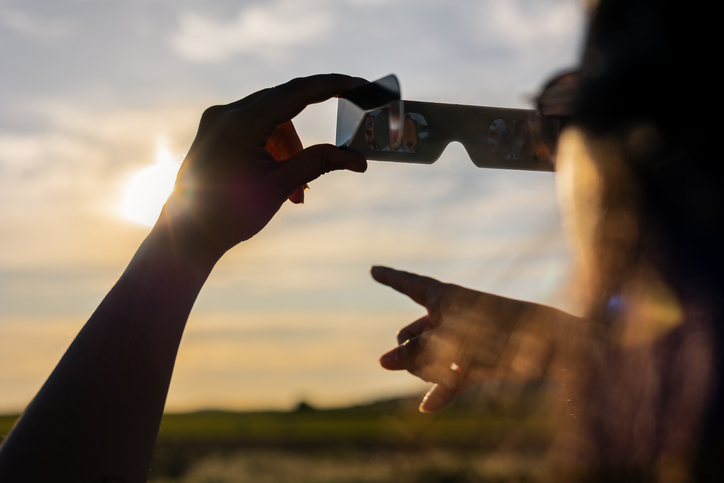
On August 12, 2026, Spain will experience an astronomical milestone: its first total solar eclipse in more than a hundred years. For just over a minute, the moon will completely block out the sun, turning day into night in a celestial spectacle that will be a once-in-a-lifetime event for several generations. It will be the first since 1905 and will be visible across much of the country, with 100% visibility along a 290-kilometer-wide diagonal strip covering the northern and central-eastern parts of the peninsula, stretching from A Coruña and Asturias toward the Valencian Community and the Balearic Islands.
This dance between the moon and the sun is a perfect choreography of predictable and awe-inspiring cosmic geometry that will begin around 7:30 p.m. This is a unique opportunity to observe the twilight corona in an open sky to the west. It will reach its climax between 8:25 p.m. and 8:32 p.m., depending on the latitude of the viewing location.
A total solar eclipse is infrequent but predictable in celestial mechanics. It occurs when the Moon is positioned exactly between the Earth and the Sun, casting its umbra (the zone of total darkness) onto the Earth's surface. Although the Sun's diameter is about 400 times greater than the Moon's, the distance to the Sun is also about 400 times greater, so both celestial bodies appear to be the same size in the sky to the human eye.
When they align, the Sun's light is completely blocked, causing an abrupt drop in temperature and sudden darkness that turns day into night in a matter of minutes. This phenomenon is much more than a historic visual spectacle. What happens when the Sun goes dark? What impact does it have on solar power grid and other renewable energy sources? And on Spain's electrical system? This total solar eclipse will also be both a practical test and a technical challenge for Spain's renewable energy grid.
An open laboratory of green energies
For science and sustainability, modern eclipses are no longer just a cosmological curiosity but also climate laboratories. Studies published in Nature and Philosophical Transactions of the Royal Society explain that when the ground cools suddenly, thermal convection in the air ceases, altering the speed and direction of surface winds. This phenomenon, known scientifically as the eclipse wind, makes weather forecasts more complex and affects wind power generation.
Another phenomenon that Nature links to a total solar eclipse involves solar power. In short, the article explains that, unlike a typical sunset — where solar output declines gradually and predictably over the course of a couple of hours — researchers estimate that the Moon's passage will reduce solar radiation at a rate ten times faster than normal. Therefore, when the Moon comes between the Sun and Earth, sunlight will drop suddenly — ten times faster than during a normal sunset — and solar power generation will fall sooner than expected.
Guide to watching the eclipse of the century
The European Space Agency (ESA) has been running campaigns for months that link scientific observation to eye-safe and environmentally friendly practices.
The ESA insists on minimizing the impact on protected natural ecosystems where observation sites are established. In addition, through the Interministerial Commission for the Trio of Eclipses attached to the Ministry of Science and Innovation, the Spanish government highlights that the use of ordinary sunglasses, X-rays, or homemade filters is ineffective and not recommended. Safe observation requires filters certified under ISO standards 12312-2, or the use of indirect projection methods that fully protect the eyes during all phases of the event.
The total solar eclipse in 2026 will also be a challenge in terms of energy that will test the capacity of Spain's electric power system and grids. The mission is to turn this historic event into a demonstration of technological resilience.