Advanced catalysts and improved processes to convert CO2 into e-fuels
SynCO2 Project
The SynCO2 project, developed by Moeve and co-financed by the Center for Industrial Technological Development (CDTI) under the IDI-20230811 file, aims to promote the development of e-fuels or synthetic fuels.
To achieve this, components, materials, and innovative processes are combined to efficiently transform the CO2 captured with green hydrogen into this type of non-biological fuels (RFNBO). This initiative contributes to the decarbonization of hard-to-electrify sectors, such as air and maritime transport, aligning with the European objectives of climate neutrality.
The project has focused on two key thermocatalytic routes:
Reverse Water Gas Shift (RWGS): conversion of CO2 into synthesis gas, which is subsequently transformed into e-fuels through the Fischer-Tropsch (FT) process.
Hydrogenation from CO2 to methanol: a strategic pathway to produce e-methanol, used as marine fuel or as a precursor to other e-fuels.
Main actions
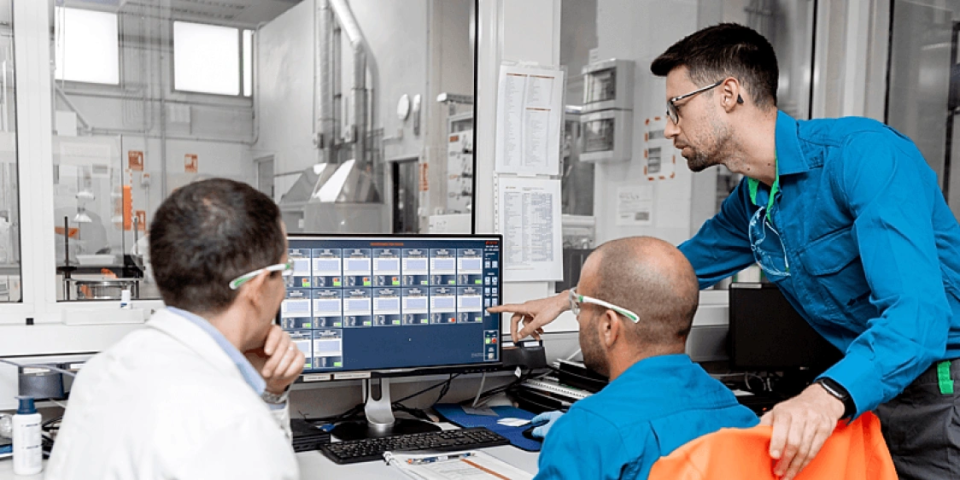
A pilot plant has been designed and built at our Innovation Center in Alcalá de Henares for CO2 conversion tests under representative conditions, and an advanced unit has been incorporated to study the complete RWGS-FT process, aimed at the synthesis of synthetic sustainable aviation fuel (e-SAF).
The partnerships with ICP-CSIC and the University of Seville have been essential for developing efficient catalysts for the RWGS process, achieving high conversions and CO selectivity (>90%) and stability under demanding conditions. As a novel aspect, advanced formulations have been created to operate at lower temperatures (≈500 °C), using non-critical metals and promoters that enhance selectivity and reduce energy consumption.
In the field of the Fischer-Tropsch process, tests have been conducted to transform the synthesis gas obtained in the RWGS into liquid hydrocarbons, optimizing the operating conditions for the production of e-SAF. This study has allowed to validate the operability of the process and establish critical parameters for its scalability.
Finally, in the CO2 hydrogenation route to methanol, state-of-the-art catalysts provided by industrial technologists have been evaluated under realistic operating conditions. In addition, strategies to intensify the process have been addressed, such as the use of adsorbents to eliminate the water generated during the reaction, resulting in improvements in conversion and selectivity.
"SynCO2 embodies Moeve's firm commitment to sustainable innovation and represents a decisive step towards decarbonization, demonstrating that it is possible to transform CO2 into a valuable resource by integrating renewable energies, scalable solutions, and highly efficient processes."
Flor García Mayoral
Energy Transition Technologies, Moeve Innovation Center.
Key Project Data
This project has been supported by the key technologies of RWGS, CO2 hydrogenation to MeOH, Fischer-Tropsch.